
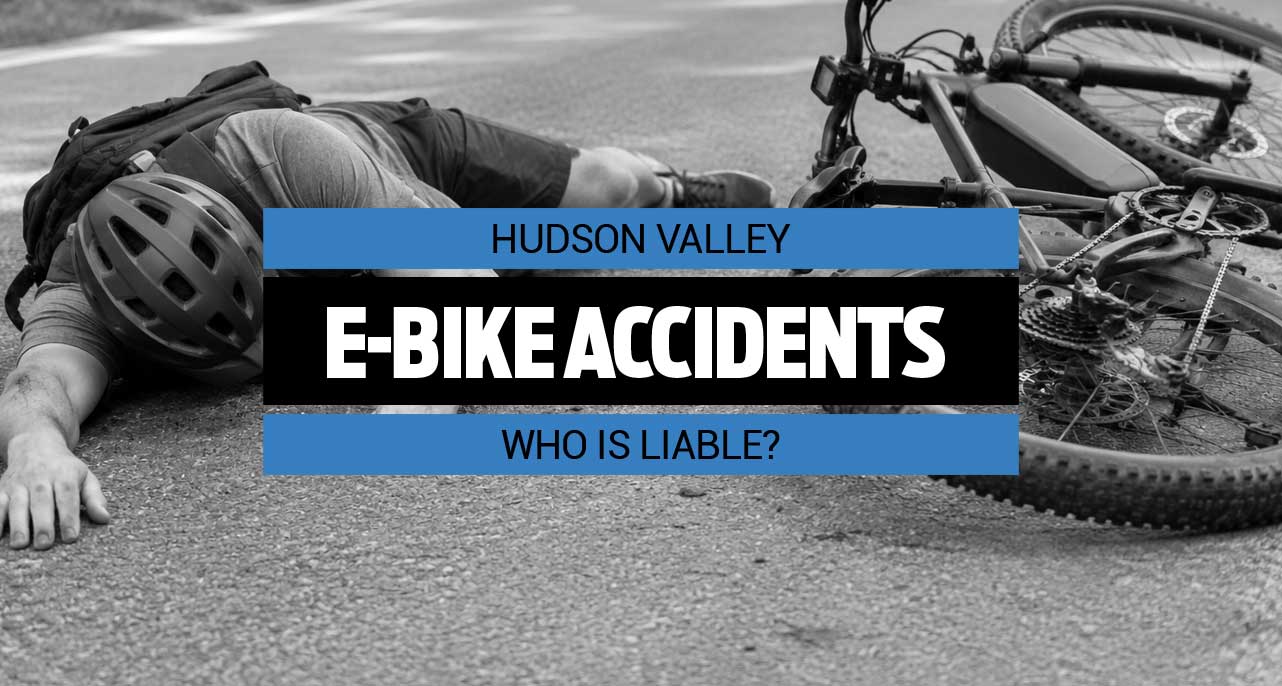
Electric bicycles have become an increasingly common way to commute, exercise and travel around the Hudson Valley. From the streets of Poughkeepsie and Newburgh to residential roads and cycling routes throughout Dutchess, Orange and Ulster counties, e-bikes offer convenience and mobility. But when an electric bicycle collides with a car, truck or pedestrian, the consequences can be severe.
E-bike riders have limited physical protection in a collision. A crash can result in broken bones, facial injuries, traumatic brain injuries, spinal cord damage and other injuries that require extensive medical treatment. In the most serious cases, an electric bicycle accident can result in permanent disability or death.
When an e-bike crash occurs, injured riders and their families may face difficult questions. Who was responsible? Does the driver of a car have to compensate an injured cyclist? Can an e-bike rider recover damages after colliding with a vehicle? What happens when a defective bicycle or dangerous roadway contributes to the accident?
For people injured in an electric bicycle crash in the Hudson Valley, understanding New York’s traffic laws and personal injury rules can help clarify the available legal options.
O’Connor & Partners, PLLC represents injured people in bicycle accidents and other serious personal injury matters throughout the Hudson Valley and New York.
Why Are E-Bike Accidents a Growing Safety Concern?
Electric bicycles combine conventional cycling with motor-assisted power. Depending on the class of bicycle, the motor may assist only while the rider pedals or may also propel the bicycle using a throttle.
This additional power can make it easier to travel longer distances and climb hills. However, riders must still navigate intersections, turning vehicles, parked cars, pedestrians and changing road conditions.
New York State recognizes three classes of electric bicycles under Vehicle and Traffic Law § 102-c. Class 1 e-bikes provide pedal assistance up to 20 mph, Class 2 e-bikes have a throttle and cease providing motor assistance at 20 mph, and Class 3 e-bikes provide assistance up to 25 mph under the statutory definition, with Class 3 operation generally restricted to New York City.
The New York State Department of Transportation explains the classifications and operating restrictions in its official e-bike frequently asked questions.
Several factors can contribute to an e-bike accident:
- Drivers turning across a cyclist’s path.
- Motorists failing to yield at intersections.
- Distracted driving.
- Unsafe passing or vehicles passing too closely.
- Poor visibility after dark.
- Road hazards, potholes and uneven pavement.
- Sudden braking or loss of control.
- Defective brakes, tires, batteries or other components.
- Conflicts between cyclists and pedestrians.
- Riders operating outside applicable traffic rules.
The cause of a particular accident matters because liability depends on the facts, the applicable law and the evidence establishing whether another party’s conduct contributed to the crash.
Common Types of E-Bike Accidents in the Hudson Valley
Electric bicycle collisions can occur in many settings, from busy commercial roads to quiet residential streets.
1. E-Bike Accidents at Intersections
Intersections present significant risks when drivers and cyclists approach from different directions or attempt to occupy the same space.
A motorist may turn left across an oncoming cyclist’s path, turn right without checking a bicycle lane or enter an intersection without yielding when required.
Because an e-bike may be moving faster than a driver expects a conventional bicycle to travel, a motorist who fails to look carefully can create a dangerous situation.
Evidence such as traffic-camera footage, witness statements, vehicle damage and the position of the bicycle may help establish how a collision occurred.
2. E-Bike Crashes Involving Cars and SUVs
A collision between an electric bicycle and a passenger vehicle can expose the rider to substantial impact forces.
The resulting injuries may include fractures, shoulder injuries, facial trauma, head injuries and damage to internal organs.
The driver may be liable if negligent conduct caused the crash. However, the investigation must establish what happened rather than assuming that the driver or cyclist was automatically at fault.
3. Dooring Accidents
A dooring accident occurs when someone opens a parked vehicle’s door into the path of an approaching cyclist.
An e-bike rider may have little time to stop or move safely out of the way. The cyclist can strike the door directly or be thrown into an adjacent traffic lane.
New York Vehicle and Traffic Law § 1214 addresses opening vehicle doors into moving traffic without taking reasonable precautions to ensure safety.
The official statute is available through the New York State Senate’s legislation website.
4. E-Bike Accidents Caused by Road Hazards
Potholes, loose gravel, uneven pavement, damaged drainage covers and poorly maintained road surfaces can cause cyclists to lose control.
In some cases, a private property owner, municipality or other party may need to be investigated. But responsibility for a roadway accident depends on issues such as who controlled the location, who had a duty to maintain it, whether the condition was legally actionable and whether the applicable notice requirements were satisfied.
Claims involving municipalities can have special procedural rules and deadlines. Anyone considering such a claim should seek legal advice promptly.
5. E-Bike Accidents Involving Pedestrians
Electric bicycles can also collide with pedestrians on shared paths, at crossings or in other areas where their movements overlap.
These accidents may involve questions about speed, visibility, right of way and the way the bicycle was operated.
The fact that an e-bike was involved does not automatically establish who was responsible. Investigators must examine the actions of everyone involved and the circumstances of the collision.
Who Is Liable for an E-Bike Accident in New York?
Liability depends on the cause of the accident and whether a person or entity failed to meet a legal duty.
In many cases, a driver who negligently causes an e-bike collision may be held responsible for the resulting injuries. Other parties may also need to be considered when the evidence supports a separate legal claim.
Negligent Drivers
Drivers have legal duties when sharing the road with bicyclists.
A claim may arise when a driver speeds, drives while distracted, makes an unsafe turn, fails to yield when required or passes a cyclist without leaving a safe distance.
New York Vehicle and Traffic Law § 1146 requires drivers to exercise due care to avoid colliding with bicyclists and pedestrians.
See New York Vehicle and Traffic Law § 1146.
Whether a violation occurred and whether it caused the accident must be evaluated using the available evidence.
Negligent Property Owners or Municipalities
If a crash resulted from a dangerous roadway or property condition, the responsible party may need to be investigated.
Potentially relevant issues include whether the defendant controlled the location, knew or should have known about the hazard, had a duty to address it and failed to take legally required precautions.
Municipal claims can involve notice-of-claim requirements and other restrictions that do not apply in the same way to ordinary claims against private individuals. The applicable deadlines must be assessed for the specific case.
Defective E-Bike Manufacturers or Sellers
Not every e-bike accident is caused by another road user.
A defective bicycle component may contribute to a crash if, for example, the brakes fail, the frame breaks or a component malfunctions under circumstances in which it should operate safely.
Depending on the facts, a claim may involve a manufacturer, distributor, seller or another party in the supply chain.
The investigation may require preserving the bicycle, obtaining maintenance records, reviewing product documentation and arranging an appropriate technical inspection.
A malfunction alone does not automatically establish a product-liability claim. Evidence must connect the alleged defect to the accident and injuries.
Other Potentially Responsible Parties
Depending on the circumstances, an accident investigation may also consider another cyclist, an employer or another party whose conduct contributed to the collision.
The aim is to identify the actual cause of the accident and the parties who may legally be responsible, rather than assuming that every e-bike crash has the same explanation.
Can an E-Bike Rider Recover Compensation if Partly at Fault?
Potentially, yes.
New York follows a comparative-negligence system in many personal injury cases. Under Civil Practice Law and Rules § 1411, a person’s own culpable conduct generally does not automatically prevent recovery, but it can reduce the damages awarded in proportion to that person’s share of responsibility.
For example, a driver may have made an unsafe turn while an e-bike rider may also have contributed to the collision. The effect on a claim depends on the evidence and applicable law.
Relevant evidence may include traffic signals, witness accounts, video footage, vehicle speed, the bicycle’s movements and whether either party violated a traffic rule.
The fact that an injured rider was not wearing a helmet, where a helmet was not legally required, should not automatically be treated as proof that the rider caused the collision. Helmet rules, injury causation and comparative fault are separate legal questions.
What Injuries Can Result From an Electric Bicycle Crash?
Although e-bikes have many practical benefits, riders remain exposed to injury when a collision occurs.
The severity of an injury depends on factors such as the impact, the speed and direction of travel, the point of contact and whether the rider strikes the ground or another object.
Traumatic Brain Injuries
A head impact can cause a concussion or a more serious traumatic brain injury. Symptoms may not be immediately apparent, which is one reason prompt medical assessment is important after a significant collision.
Severe brain injuries may affect memory, concentration, mobility, behavior and the ability to work or live independently.
Broken Bones and Orthopedic Injuries
E-bike crashes can result in fractures involving the arms, wrists, shoulders, legs, hips and other parts of the body.
Some injuries require surgery, immobilization or months of rehabilitation. Complications may interfere with employment and everyday activities long after the initial accident.
Spinal Cord and Back Injuries
A collision or fall can injure the spine, discs or surrounding structures. Severe spinal cord injuries can cause lasting mobility limitations or paralysis.
The long-term consequences may include continuing medical care, rehabilitation, assistive equipment and changes to a person’s living environment.
Facial Injuries and Scarring
A rider who strikes the pavement or a vehicle may suffer facial fractures, dental injuries, lacerations or permanent scarring.
Depending on the injury, treatment may involve surgery, dental care, scar management and psychological support.
Internal Injuries
Blunt-force trauma can damage internal organs or cause internal bleeding. These injuries may be difficult to recognize without medical evaluation and can require emergency treatment.
What Compensation May Be Available After an E-Bike Accident?
If another party is legally responsible for an electric bicycle crash, an injured person may be able to pursue compensation for damages supported by the evidence.
Depending on the circumstances, recoverable damages may include:
Medical expenses: Emergency treatment, hospitalization, surgery, medication, rehabilitation and other eligible medical costs.
Future medical care: Continuing treatment, rehabilitation, assistive devices or other future needs associated with lasting injuries.
Lost wages: Income lost because the injury prevents someone from working.
Reduced earning capacity: Financial losses associated with long-term limitations on the person’s ability to work.
Pain and suffering: Physical pain, emotional consequences and limitations on everyday activities, where legally recoverable.
Permanent impairment or scarring: The effects of lasting physical injuries on appearance, mobility and quality of life.
Other legally recoverable losses: Additional damages may be available depending on the facts and applicable law.
There is no fixed settlement amount for an e-bike accident. The value of a claim depends on the injuries, the evidence of liability, the financial consequences, available insurance and other case-specific factors.
What Should You Do After an E-Bike Crash?
The steps taken after a crash can help protect your health and preserve evidence.
1. Get Medical Attention
Seek prompt medical care after a significant collision, especially if you experience head pain, dizziness, confusion, severe pain, difficulty moving or other concerning symptoms.
Do not assume that an injury is minor simply because you were able to leave the scene.
2. Report the Accident
Contact emergency services or law enforcement when appropriate. An official report may document the parties involved, the location and other details relevant to the incident.
3. Photograph the Scene
If it is safe, photograph the bicycle, vehicles, visible injuries, roadway, traffic signals and any apparent hazards.
These photographs may help establish the conditions at the time of the crash.
4. Obtain Witness Information
Record the names and contact details of witnesses who saw the collision. Their observations may help clarify disputed issues.
5. Preserve the E-Bike
If a mechanical problem may have contributed to the crash, do not discard or substantially alter the bicycle before obtaining appropriate advice. Preserve relevant components, purchase documents, maintenance records and available technical information.
6. Keep Medical and Financial Records
Save medical bills, treatment records, receipts, employment records and documentation of missed work.
These documents can help establish the consequences of the injury.
7. Be Careful With Insurance Communications
Provide accurate information, but understand the terms of any release or settlement before signing. An early settlement may affect your ability to seek additional compensation for injuries that become clearer later.
8. Understand the Deadlines
Personal injury claims are subject to statutes of limitation. Claims involving municipalities or other public entities may have additional notice requirements and shorter deadlines.
The applicable deadline depends on the facts and parties involved, so prompt legal guidance can be important.
New York E-Bike Laws: What Riders Should Know
New York has specific rules governing electric bicycles, including classifications, operating locations and restrictions on their use.
Under Vehicle and Traffic Law § 1242, local governments may have authority to regulate certain aspects of e-bike operation, including where and how the bicycles may be used, subject to state law.
The New York State Department of Transportation states that Class 1 and Class 2 e-bikes are generally permitted throughout New York State unless specifically prohibited by local law, while Class 3 e-bikes are restricted to New York City under the current statutory framework. E-bikes are generally permitted on streets and highways with posted speed limits of 30 mph or less, subject to applicable restrictions and local rules.
Because local rules can vary, riders should verify the requirements applicable to their specific route and municipality.
Official resources include:
- New York State Department of Transportation: E-Bike FAQs
- New York Vehicle and Traffic Law § 102-c: Bicycle With Electric Assist
- New York Vehicle and Traffic Law § 1242: Operation of Bicycles With Electric Assist
Riders should also understand that electric bicycles are not necessarily treated the same as every other motorized vehicle. The legal classification of the device can affect which rules apply.
E-Bike Accidents in Poughkeepsie, Newburgh, Kingston and the Hudson Valley
Electric bicycle crashes can occur throughout the region, including on busy local roads, at intersections, near commercial areas and on routes shared by cyclists and motor vehicles.
O’Connor & Partners, PLLC serves clients throughout the Hudson Valley, including communities in Dutchess, Orange and Ulster counties.
The firm’s existing practice pages provide additional information about bicycle accident representation and car accident claims.
For an injured e-bike rider, the investigation may need to consider the driver’s conduct, the bicycle’s condition, road design, visibility, traffic rules and the long-term consequences of the injury.
The specific location of the accident can also matter when determining whether a municipality or another party may be responsible for a roadway hazard.
How O’Connor & Partners Can Help After an E-Bike Accident
After a serious electric bicycle crash, injured people may face medical expenses, lost income, rehabilitation and uncertainty about how the accident occurred.
O’Connor & Partners, PLLC represents injured people in personal injury matters throughout the Hudson Valley and New York.
Depending on the facts, evaluating an e-bike accident may involve reviewing the police report, examining available video footage, identifying witnesses, assessing potential insurance coverage and determining whether the evidence supports a claim against a driver or another responsible party.
The firm also handles other serious injury matters. Learn more about its serious injury attorneys or visit the firm’s contact page to discuss a potential case.
Every accident is different, and no legal outcome can be guaranteed. A case review can help clarify the issues that may need to be investigated and the legal options available.
Frequently Asked Questions About E-Bike Accidents in New York
Can I sue a driver who hits me while I am riding an e-bike?
Potentially. If a driver’s negligent conduct caused the collision and your injuries, you may be able to pursue compensation. The outcome depends on the evidence and applicable law.
What if an e-bike accident was caused by a defective bicycle?
A product-liability claim may be possible if a defect contributed to the crash. The bicycle and relevant components should be preserved where possible so the alleged defect can be properly investigated.
Can I recover compensation if I was partly responsible for the accident?
Potentially. New York’s comparative-negligence rules generally allow recovery to be reduced according to a claimant’s share of responsibility rather than automatically barred, subject to the applicable law and circumstances.
Do New York e-bike laws affect my injury claim?
They can. The bicycle’s classification, where it was operated and whether applicable traffic rules were followed may be relevant to the investigation. A violation does not automatically resolve every question of liability.
How long do I have to file an e-bike accident lawsuit?
The deadline depends on the legal claim and the parties involved. Different rules may apply to claims against public entities, and additional notice requirements may apply. Obtain legal advice promptly rather than assuming one deadline applies to every case.
What if I suffered a head injury in an e-bike crash?
Seek medical attention promptly. Head injuries can have serious consequences even when symptoms are initially subtle. Keep records of treatment and follow medical guidance.
Speak With a Hudson Valley Bicycle Accident Attorney
An electric bicycle crash can change a person’s life in a matter of seconds. Serious injuries may require extensive treatment and create financial challenges long after the accident.
Understanding how the crash occurred, preserving evidence and identifying potentially responsible parties can be important steps toward protecting your legal rights.
O’Connor & Partners, PLLC represents injured people in bicycle accidents and other serious personal injury matters throughout the Hudson Valley and New York.
If you or a family member has been injured in an e-bike collision, visit the firm’s bicycle accident practice page or contact O’Connor & Partners to discuss the circumstances of the accident.
This article provides general information about New York law and is not legal advice. The availability and value of a claim depend on the facts, evidence and applicable legal requirements.