
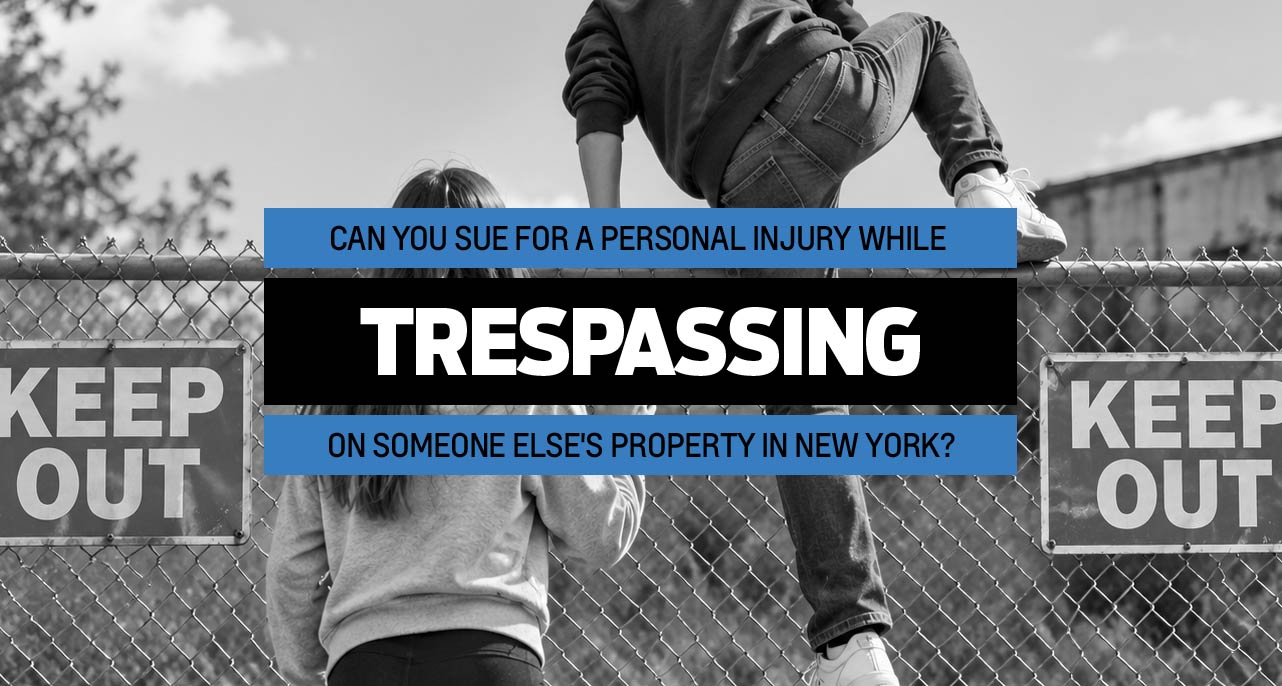
Being injured on someone else’s property can create complicated legal questions. But what happens when the injured person was not supposed to be there in the first place?
Imagine someone enters an abandoned building and falls through a damaged floor. A teenager walks onto an unsecured construction site and falls into an uncovered excavation. A person cuts across a vacant lot and suffers serious injuries after encountering a dangerous condition that the property owner knew existed.
In each situation, the property owner might argue that the injured person was trespassing and therefore has no right to compensation.
But is that always true under New York law?
No. Being injured while trespassing does not automatically eliminate every possible personal injury claim in New York. The circumstances surrounding the accident, the nature of the dangerous condition, the foreseeability of the person’s presence and the property owner’s conduct may all matter.
New York courts generally evaluate property-related negligence claims under a standard of reasonable care under the circumstances. A person’s status as a trespasser remains relevant, but it does not necessarily end the legal analysis.
For someone who has suffered a serious injury on private property without permission, understanding this distinction can be important when evaluating potential legal options.
Does Trespassing Automatically Prevent You From Filing a Personal Injury Lawsuit?
One of the most common misconceptions about premises liability is that a property owner can never be held responsible when someone is injured while trespassing.
New York law is more complicated.
In Basso v. Miller, 40 N.Y.2d 233 (1976), the New York Court of Appeals adopted a general standard requiring property owners and occupiers to exercise reasonable care under the circumstances.
The court moved away from treating the traditional classifications of trespassers, licensees and invitees as the sole determining factor in establishing a property owner’s duty.
Instead, the court explained that foreseeability is an important consideration. The likelihood that someone would be present at a particular location and the possibility of injury are relevant when determining what reasonable care requires.
This does not mean that property owners must make every part of their property safe for anyone who might enter without permission.
Rather, the circumstances matter.
For example, an owner of a remote, securely fenced industrial property may face different questions from the owner of an unsecured vacant lot located next to a residential neighborhood where people regularly walk.
The nature of the property, the dangerous condition, the likelihood of someone entering and the burden of taking precautions may all affect the analysis.
Read the decision: Basso v. Miller, 40 N.Y.2d 233 (1976).
What Duty Does a New York Property Owner Owe to a Trespasser?
New York generally applies the reasonable-care standard established in Basso v. Miller.
However, the fact that someone entered property without permission can still be important when determining whether the property owner acted reasonably.
Courts may consider several factors:
- Was the injured person’s presence reasonably foreseeable?
- Was the property accessible to members of the public?
- Had other people entered the property without permission?
- Was the dangerous condition known to the property owner?
- Did the owner know or have reason to anticipate that someone could encounter the hazard?
- How serious was the potential injury?
- How difficult or expensive would it have been to eliminate or reduce the danger?
- Was the injured person’s conduct reasonable under the circumstances?
A property owner is not automatically liable simply because a dangerous condition existed.
The injured person generally must establish the applicable duty, a breach of that duty, causation and legally recognizable damages.
The analysis is particularly fact-specific when the injured person was deliberately entering an area marked as private or restricted.
A New York Court Decision Involving an Injured Trespasser
An important example is Soich v. Farone, 307 A.D.2d 658 (3d Dep’t 2003).
The case involved a plaintiff who was injured on a vacant lot while trespassing. The defendants argued that their status as property owners meant they owed no duty to the injured person.
The Appellate Division rejected the argument that trespassing status automatically eliminated the owner’s duty to exercise reasonable care.
The court explained that the relevant analysis could involve the nature of the alleged defect, the burden of remedying it and the foreseeability of the plaintiff’s presence on the property.
The court also distinguished between the duty to warn about a condition and the broader obligation to maintain property in a reasonably safe condition.
Importantly, the court did not declare that the property owners were automatically liable. It concluded that the issues could not be resolved simply by relying on the plaintiff’s trespassing status.
The decision demonstrates why the circumstances of an accident can matter more than the label assigned to the injured person.
Read the decision: Soich v. Farone, 307 A.D.2d 658.
Five Situations Where a Trespasser May Suffer a Serious Injury
Trespassing-related injuries can happen in many different environments. The legal issues depend on the property, the dangerous condition and the circumstances of the person’s entry.
1. Injured on an Abandoned Construction Site
Abandoned or inactive construction sites can contain serious hazards.
A person entering an unsecured site may encounter:
- Uncovered excavations.
- Open trenches.
- Unprotected stairwells.
- Unstable scaffolding.
- Exposed electrical wiring.
- Unsecured machinery.
- Unstable walls or partially demolished structures.
- Construction debris and hidden openings.
Consider a vacant construction site located in a residential neighborhood. The property has no visible fencing, warning signs or barriers. A person enters the site and falls into a deep, uncovered excavation.
The owner may argue that the injured person had no permission to enter.
However, the investigation may need to examine whether the property was adequately secured, whether the owner knew about the excavation, whether people were likely to enter the site and whether reasonable precautions could have prevented the injury.
A relevant New York decision is Fagan v. Long Island Realty & Development, Ltd. (Sup. Ct. Nassau County 2007).
In that case, the plaintiff entered an unsecured construction site and fell into an uncovered pit. The court considered the absence of a construction fence, warnings and other safeguards, along with whether the property owner’s knowledge of the surrounding circumstances made the plaintiff’s presence reasonably foreseeable.
The decision was made by a trial-level court, rather than the New York Court of Appeals, but it illustrates the type of factual questions that can arise in a trespasser injury case.
Read the decision: Fagan v. Long Island Realty & Development, Ltd..
2. Injured Inside an Abandoned or Vacant Building
Vacant buildings can deteriorate over time, particularly when they are not regularly inspected or maintained.
A person entering an abandoned structure may encounter:
- Rotten or unstable flooring.
- Collapsing staircases.
- Missing railings.
- Broken balconies.
- Unsecured elevators.
- Falling ceiling materials.
- Exposed electrical systems.
- Structural instability.
Suppose a building owner knows that teenagers frequently enter an unsecured vacant property. The owner also knows that a section of the upper floor has deteriorated and could collapse.
If someone enters the building and falls through that floor, the circumstances may raise questions about foreseeability, property maintenance and the precautions taken by the owner.
The injured person’s unauthorized entry remains relevant, but it does not automatically answer every question concerning the owner’s potential responsibility.
3. A Child Enters Private Property and Suffers an Injury
Cases involving children require particular attention.
Children may not recognize hazards in the same way as adults. Their natural curiosity, tendency to explore and limited ability to appreciate certain dangers may be relevant when evaluating what a property owner should reasonably anticipate.
For example, a child may enter an unsecured property and suffer an injury involving:
- An uncovered swimming pool.
- An abandoned vehicle.
- Dangerous machinery.
- An exposed electrical installation.
- An unstable structure.
- An unsecured excavation.
However, it is important to understand New York’s actual legal position.
New York has historically rejected the traditional attractive nuisance doctrine as a separate basis for imposing liability on property owners. In Morse v. Buffalo Tank Corp., 280 N.Y. 110 (1939), the Court of Appeals addressed and rejected that doctrine.
That does not mean a child’s presence and behavior are irrelevant.
In Mayer v. Temple Properties, Inc., 307 N.Y. 559 (1954), the Court of Appeals discussed how a jury may consider children’s natural tendencies to climb, explore and play when evaluating reasonable care.
Similarly, in Barker v. Parnossa, Inc., 39 N.Y.2d 926 (1976), the Court of Appeals addressed the foreseeable conduct of children around dangerous conditions.
The important distinction is that New York does not simply apply an automatic attractive-nuisance rule whenever a child is injured by something interesting or dangerous on private property. Instead, the circumstances and the ordinary principles of negligence must be examined.
4. Injured While Crossing Railroad or Industrial Property
Railroad tracks, industrial facilities and utility properties often contain dangerous conditions and restricted areas.
Someone who enters without permission may encounter:
- Moving trains or industrial vehicles.
- Exposed electrical equipment.
- Dangerous machinery.
- Chemical substances.
- Unprotected elevated platforms.
- Deep drainage areas.
- Unstable industrial structures.
These cases can involve additional legal issues beyond ordinary premises liability.
For example, a railroad accident may require investigation of train operations, warnings, access restrictions, surveillance footage, maintenance records and the actions of railroad personnel.
A person’s unauthorized presence can be highly relevant, but the facts must still be examined before determining whether any party may have legal responsibility.
5. Injured by a Dangerous Condition or Deliberately Created Hazard
Another situation involves dangerous conditions that may have been created or maintained in a way that presents a serious risk to anyone entering the property.
Examples may include:
- Exposed live electrical wires.
- Dangerous machinery left operating without safeguards.
- Unstable structures known to be at risk of collapse.
- Hazardous materials stored improperly.
- Unsecured equipment capable of causing serious injury.
The legal significance depends on how the condition arose, whether the property owner knew about it, what precautions were taken and whether the conduct involved ordinary negligence or something more serious.
New York law distinguishes between failing to maintain property reasonably and deliberately or recklessly creating a dangerous situation.
The specific facts are essential.
Can a Property Owner Be Liable If a Trespasser Falls Into an Uncovered Hole?
Potentially, yes.
An uncovered excavation is a useful example because it raises several questions about the property owner’s knowledge and the foreseeability of an injury.
Consider a property containing a deep pit or excavation that has been left uncovered.
If the area is accessible, located near a residential neighborhood and has no fence, warning signs or other protective measures, an investigation may examine whether the owner should reasonably have anticipated that someone could enter and suffer an injury.
The relevant questions may include:
- How long had the excavation existed?
- Was the owner aware of it?
- Was the property secured?
- Were warning signs or barriers installed?
- Had people previously entered the property?
- Was the excavation visible from surrounding areas?
- Could the danger have been eliminated or reduced through reasonable precautions?
The absence of permission to enter the property is relevant, but it does not necessarily dispose of the claim.
The court must consider the complete circumstances and the applicable duty of care.
What If the Property Owner Knew People Were Entering Without Permission?
This can be an important part of a trespasser injury investigation.
A property owner may have a different foreseeability problem when unauthorized entry is not an isolated or completely unexpected event.
For example, consider a vacant commercial property where:
- Neighbors regularly report people entering the building.
- Security personnel have previously removed unauthorized visitors.
- The owner has received complaints about children entering the property.
- A dangerous opening has remained accessible for an extended period.
- The owner has taken no reasonable steps to secure the area.
Evidence of previous unauthorized entry may help establish that the owner’s knowledge of the surrounding circumstances should have affected the precautions taken.
However, repeated trespassing does not automatically make the owner liable for every subsequent injury.
The nature of the danger, the location, the person’s conduct and the burden of taking precautions remain relevant.
Can a Trespasser Still Be Partially Responsible for Their Own Injuries?
Yes.
New York follows a comparative negligence system.
Under New York Civil Practice Law and Rules § 1411, a person’s culpable conduct generally does not automatically prevent recovery in a personal injury action.
Instead, damages may be reduced according to the injured person’s percentage of responsibility.
For example, suppose a person enters a vacant property without permission and is injured after falling into an excavation.
A jury might determine that the property owner failed to take reasonable precautions and that the injured person also acted carelessly by entering the restricted area.
If the jury assigns 60% responsibility to the injured person and 40% to the property owner, the injured person’s recoverable damages would generally be reduced by 60%.
The example is illustrative only. Actual fault allocation depends on the evidence and applicable law.
This is one reason why trespassing cases require careful evaluation. The fact that someone entered without permission may affect the assessment of responsibility and damages, but it is not necessarily an automatic bar to recovery.
What Evidence Is Important in a Trespasser Personal Injury Claim?
The circumstances surrounding the accident may determine whether a property owner or another party can be held responsible.
Evidence should establish not only how the injury occurred but also what the property owner knew, what precautions were taken and whether the injured person’s presence was reasonably foreseeable.
Important evidence may include:
Photographs and Videos of the Property
Photographs can document the exact condition that caused the accident.
Useful images may show:
- The entrance to the property.
- Fences, gates and barriers.
- Warning signs.
- The dangerous condition.
- The surrounding area.
- Lighting conditions.
- The visibility of the hazard.
- The general condition of the building or land.
It may also be important to document whether the property was visibly abandoned, unsecured or accessible from a public area.
Surveillance Footage
Security cameras may show whether people regularly entered the property, whether the owner or security personnel were aware of the activity, and what happened immediately before the accident.
Nearby businesses or residential properties may also have relevant recordings.
Surveillance footage can be deleted or overwritten, so preservation may be important.
Maintenance and Inspection Records
Property maintenance records may help establish whether the owner knew about the dangerous condition.
Relevant documents may include:
- Inspection reports.
- Repair requests.
- Maintenance schedules.
- Security reports.
- Contractor agreements.
- Previous incident reports.
- Communications concerning the condition of the property.
Previous Complaints and Incidents
Complaints from neighbors, tenants, employees or other visitors may help establish that a dangerous condition or recurring unauthorized access was known.
Previous incidents involving similar hazards may also be relevant, depending on the circumstances and applicable evidentiary rules.
Witness Statements
People living or working near the property may know whether it was regularly entered without permission, whether the owner had been notified of dangerous conditions or whether warning signs and barriers were previously installed.
Their observations may become important when evaluating foreseeability and the owner’s knowledge.
Expert Investigation
In serious cases, engineering, construction safety or other technical experts may help examine the dangerous condition.
For example, an expert may assess whether a staircase was structurally unstable, whether an excavation should have been protected, or whether a building component was likely to collapse.
Expert findings may help explain the physical cause of the accident and whether reasonable precautions could have reduced the risk.
What Compensation May Be Available After a Trespassing Injury?
If the injured person establishes a valid personal injury claim, potential compensation may include:
- Emergency medical treatment.
- Hospitalization and surgery.
- Physical therapy and rehabilitation.
- Prescription medication.
- Medical equipment.
- Future medical expenses.
- Lost income.
- Reduced future earning capacity.
- Pain and suffering.
- Permanent impairment or disability.
- Other legally recoverable losses supported by the evidence.
The value of a claim depends on the severity of the injuries, the evidence of negligence, the injured person’s own conduct, available insurance coverage and the applicable law.
A serious injury does not automatically establish liability. Similarly, unauthorized entry does not automatically establish that the injured person has no claim.
Both issues must be evaluated separately.
What Should You Do If You Are Injured While Trespassing on Private Property?
After a serious accident, obtaining medical care should be the first priority.
Once immediate medical needs have been addressed, several steps may help preserve evidence and protect your legal options.
1. Seek medical attention.
Obtain appropriate medical evaluation and follow the treating professionals’ instructions. Some injuries may not become immediately apparent.
2. Document the accident scene.
If it is safe and lawful to do so, preserve photographs of the condition that caused the injury and the surrounding property.
3. Identify the property owner.
Determine who owns, occupies or controls the location. The owner may not be the same entity responsible for daily maintenance or security.
4. Identify witnesses.
People who live nearby, work on the property or previously observed the dangerous condition may have relevant information.
5. Preserve relevant records.
Keep medical documents, accident reports, photographs, communications and other information connected to the injury.
6. Avoid altering or removing physical evidence.
Potentially relevant equipment, materials or objects should not be disturbed unnecessarily.
7. Speak with a personal injury attorney.
A lawyer can examine the circumstances of the entry, the dangerous condition, the property owner’s knowledge and the applicable legal rules.
You should not assume that a claim is impossible simply because you were not authorized to enter the property.
How Long Do You Have to File a Trespasser Injury Lawsuit in New York?
The applicable deadline depends on the facts and the parties involved.
Many ordinary personal injury negligence claims in New York are subject to a three-year statute of limitations under New York CPLR § 214.
However, different rules may apply when the defendant is a municipality, public authority or another governmental entity.
For example, claims subject to New York General Municipal Law § 50-e may require a notice of claim within 90 days, with additional procedural requirements and exceptions depending on the circumstances.
Claims involving minors, wrongful death and other special circumstances may also be subject to different rules.
It is important not to assume that the ordinary three-year deadline applies to every trespassing injury case.
Prompt legal advice can help identify the correct deadline and determine what evidence needs to be preserved.
Frequently Asked Questions About Personal Injury While Trespassing in New York
Can you sue a property owner if you were trespassing?
Potentially. New York courts apply a reasonable-care standard under the circumstances. A person’s trespassing status is relevant, particularly when considering foreseeability and the precautions reasonably required, but it does not automatically eliminate every possible claim.
Does a property owner have to make their property safe for trespassers?
Not in the sense of guaranteeing that every unauthorized visitor will be protected from every dangerous condition. The owner’s obligations depend on the circumstances, including the nature of the hazard, the foreseeability of someone’s presence and the burden of taking reasonable precautions.
Can you sue if you were injured in an abandoned building?
Potentially. The condition of the building, how accessible it was, whether the owner knew about dangerous conditions and whether unauthorized entry was foreseeable may all matter.
What happens if a child is injured while trespassing?
The child’s age and ability to appreciate the danger may be relevant when evaluating reasonable care. New York does not recognize the traditional attractive nuisance doctrine as a separate general rule, but courts may consider children’s natural behavior and the foreseeability of their presence.
Can a property owner be liable if someone enters through an unlocked gate?
Possibly. An unlocked gate alone does not establish liability. However, the property’s accessibility, previous unauthorized entry, the owner’s knowledge and the nature of the dangerous condition may be relevant.
Can you recover compensation if you were partially responsible for the accident?
Potentially. New York’s comparative negligence law generally allows recovery even when the injured person shares responsibility, although damages may be reduced according to the person’s percentage of fault.
Does a property owner have to install fences around every dangerous area?
There is no universal requirement to fence every dangerous condition on every private property. Specific statutes, regulations, property conditions and the circumstances of foreseeable entry may affect what precautions are required.
Does trespassing mean the injured person committed a crime?
Unauthorized entry can raise separate criminal or civil legal issues depending on the circumstances. However, whether conduct constitutes trespassing and whether a property owner may be civilly liable for an injury are distinct legal questions.
Injured While Trespassing on Someone Else’s Property in New York?
An accident on private property can create complicated legal issues, particularly when the injured person did not have permission to be there.
Property owners may argue that unauthorized entry prevents an injured person from recovering compensation. However, New York decisions such as Basso v. Miller and Soich v. Farone demonstrate why the full circumstances of the accident must be examined.
The nature of the dangerous condition, the likelihood of someone entering the property, the owner’s knowledge and the precautions that could reasonably have been taken may all be relevant.
O’Connor & Partners, PLLC represents people who have suffered serious injuries in premises liability, construction accidents, slip and fall incidents and other personal injury matters throughout New York.
Learn more about the firm’s premises liability representation and serious injury legal services.
If you were injured on private property, even if you were not authorized to enter, contact O’Connor & Partners, PLLC to discuss the circumstances and potential legal options.
This article is for general informational purposes only and does not constitute legal advice. Whether a property owner may be liable depends on the facts, applicable law, evidence and procedural requirements of the individual case.