
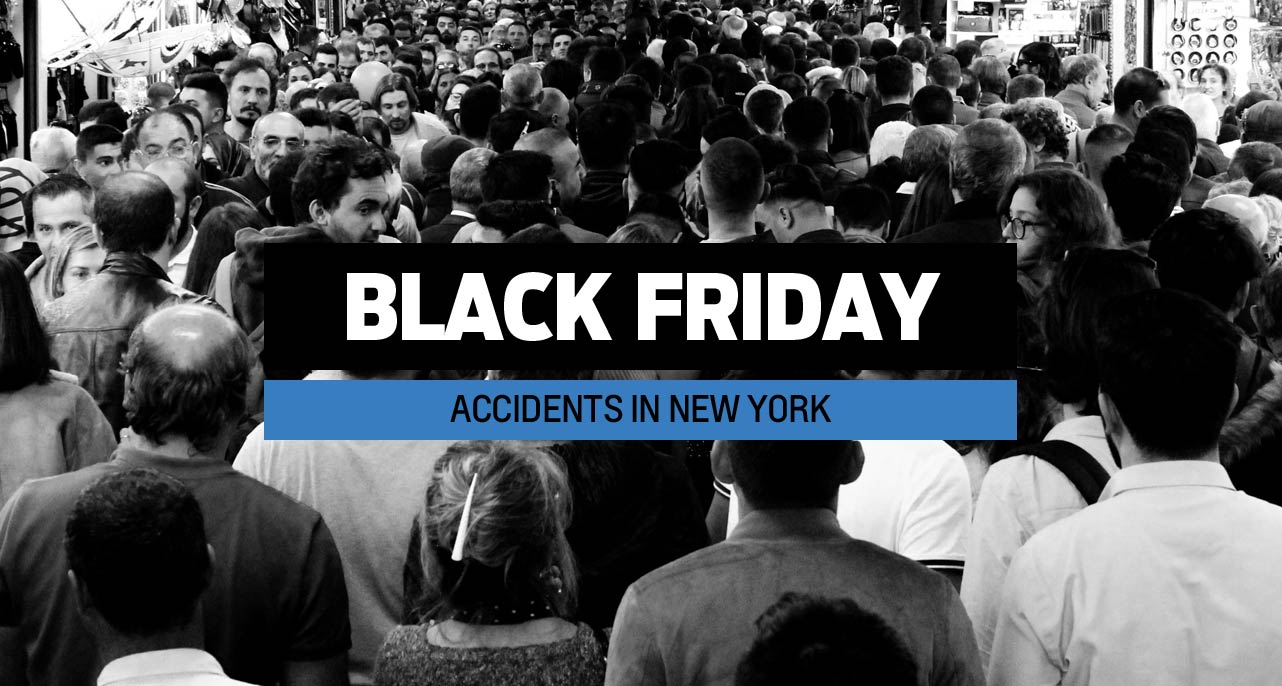
Black Friday brings some of the busiest shopping activity of the year. Retail stores, shopping malls, department stores and large shopping centers attract customers looking for limited-time discounts, holiday gifts and promotional offers.
But crowded stores and aggressive sales events can also create dangerous conditions.
Shoppers may be knocked down in crowded aisles, injured by falling merchandise, struck by shopping carts, or caught in sudden surges of people rushing toward discounted products. Others slip on wet floors, trip over merchandise or suffer injuries in poorly managed parking lots.
When these accidents happen, an important question arises: Can a store be held legally responsible if a customer is injured during Black Friday shopping in New York?
In certain circumstances, yes.
New York property owners and business operators generally have a duty to maintain their premises in a reasonably safe condition. Depending on the circumstances, a retailer may face liability when an injury results from a dangerous condition it created, knew about, or should reasonably have discovered and addressed.
Crowd management can also become an important issue when a store anticipates unusually large numbers of customers but fails to take reasonable precautions to protect shoppers.
For someone injured during Black Friday shopping, understanding the circumstances of the accident, the store’s responsibilities and the evidence needed to establish negligence can be essential when evaluating a personal injury claim.
Why Black Friday Shopping Can Create Serious Accident Risks
Black Friday promotions can bring unusually large numbers of customers into retail stores, sometimes within a relatively short period.
Although many retailers now distribute promotions across several days or weeks, in-store sales can still produce crowded entrances, busy aisles, long checkout lines and congested parking areas.
Several conditions may contribute to accidents.
1. Crowd Surges and Shopping Stampedes
One of the most serious Black Friday hazards occurs when large groups of shoppers move toward the same entrance, product display or promotional area.
For example, a retailer may advertise a limited quantity of heavily discounted televisions, appliances or other high-demand products. When customers are allowed to enter simultaneously, a sudden surge can develop.
People may be pushed off balance, knocked to the ground or trapped between other shoppers and fixed objects.
Potential injuries include:
- Broken bones.
- Head and traumatic brain injuries.
- Back and spinal injuries.
- Chest injuries.
- Internal injuries.
- Crush-related injuries.
- Serious injuries caused by falls and trampling.
A store that expects unusually large crowds may need to consider reasonable crowd-management measures, depending on the circumstances.
These may include trained personnel, controlled entry, appropriate barriers, clearly marked queues, occupancy management and emergency procedures.
The central legal question is whether the retailer took reasonable steps to address risks that could have been anticipated.
2. Slip and Fall Accidents Inside Stores
Crowded retail environments can make it more difficult to keep floors and walkways clear.
Customers may spill drinks, drop food, track rainwater into the building or leave packaging and merchandise in walking areas.
During the holiday shopping season, stores may also experience increased foot traffic around entrances, checkout counters and promotional displays.
Common causes of Black Friday slip and fall accidents include:
- Wet floors near entrances.
- Spilled beverages or food.
- Broken containers.
- Leaking refrigeration units.
- Merchandise or packaging left on the floor.
- Damaged flooring.
- Poorly maintained restroom areas.
- Inadequate warning signs around recently cleaned floors.
A retailer is not automatically responsible for every spill or fall. However, if the store created the dangerous condition or had actual or constructive notice of it and failed to take reasonable corrective action, a customer may have grounds for a premises liability claim.
3. Injuries Caused by Falling Merchandise
Retailers often place products on temporary promotional displays, stacked pallets and shelves to make discounted merchandise more accessible.
When merchandise is improperly stacked, unstable or positioned above customers’ heads, products may fall and cause injuries.
A shopper may be struck by a falling television, appliance, box or other heavy item.
Potentially relevant questions include:
- Was the merchandise stacked safely?
- Were shelves or displays overloaded?
- Were heavy products placed at unsafe heights?
- Had employees been notified that the display was unstable?
- Did the store use temporary promotional structures without adequate safeguards?
- Were customers required to reach into an unsafe display?
Depending on the circumstances, a retailer, property operator or another responsible party may face liability.
4. Shopping Cart and Aisle Accidents
Busy aisles can create collisions between shoppers, shopping carts and store equipment.
A customer may be struck by a cart pushed too quickly, knocked over while trying to move around a promotional display or injured when employees move merchandise through an overcrowded aisle.
Accidents can also happen when:
- Shopping carts are damaged or difficult to control.
- Pallets obstruct pedestrian routes.
- Merchandise is left in walkways.
- Employees move stock through crowded customer areas.
- Temporary displays reduce available walking space.
A crowded store does not eliminate the retailer’s responsibility to consider customer safety.
5. Escalator and Elevator Accidents in Shopping Malls
Black Friday shopping often involves multiple floors of retail stores and shopping centers.
Escalators and elevators may experience increased use, creating additional risks when equipment is defective or poorly maintained.
Potential accidents include:
- Falls on escalators.
- Entrapment injuries.
- Sudden escalator stops.
- Malfunctioning elevator doors.
- Slips near escalator entrances.
- Injuries caused by overcrowding.
These incidents may require investigation into maintenance records, inspection history, equipment condition and the responsibilities of the property owner or maintenance contractor.
6. Parking Lot Accidents and Pedestrian Injuries
The risks associated with Black Friday shopping do not end at the store entrance.
Shopping center parking lots can become congested as customers search for available spaces, drive between stores and enter or exit parking areas.
Pedestrians may be struck by vehicles backing out of parking spaces or turning through pedestrian routes.
Other hazards include:
- Poorly illuminated parking areas.
- Damaged pavement.
- Snow and ice.
- Inadequate pedestrian crossings.
- Vehicles blocking walkways.
- Unsafe traffic patterns.
- Poorly maintained sidewalks.
Depending on the location and circumstances, a claim may involve the driver, shopping center owner, parking operator or another responsible party.
Can You Sue a Store for a Black Friday Injury in New York?
Potentially.
New York law generally requires property owners and business operators to maintain their premises in a reasonably safe condition under the circumstances.
In a retail setting, this responsibility can include reasonably inspecting customer areas, addressing dangerous conditions and taking appropriate precautions against foreseeable hazards.
However, an injury occurring inside a store does not automatically establish negligence.
In most premises liability cases, the injured person must establish that the defendant owed an applicable duty of care, breached that duty, and that the breach caused the injury.
One of the most important issues in a retail slip and fall case is whether the store created the dangerous condition or had actual or constructive notice of it.
Actual Notice
Actual notice generally means the store knew about the dangerous condition before the accident.
For example:
- An employee saw a liquid spill but did not clean it.
- A customer reported merchandise blocking an aisle.
- A manager received a complaint about a damaged floor.
- Staff members knew that a promotional display was unstable.
Evidence of prior complaints, employee statements and incident reports may help establish actual notice.
Constructive Notice
Constructive notice may exist when a dangerous condition was visible and apparent and had been present long enough that the store should reasonably have discovered and corrected it.
For example, if a spill remained on a busy supermarket floor for an extended period, the store may face questions about its inspection and cleaning procedures.
New York courts have repeatedly addressed this issue in retail premises liability cases.
In Gordon v. American Museum of Natural History, 67 N.Y.2d 836 (1986), the New York Court of Appeals explained that constructive notice requires evidence that the dangerous condition was visible and apparent and existed for sufficient time before the accident to permit discovery and correction.
This principle is relevant to accidents involving wet floors, spilled products and other hazards in retail stores.
Read the decision: Gordon v. American Museum of Natural History.
The Store May Need to Show When the Area Was Last Inspected
Inspection records can become particularly important when a customer slips or trips in a store.
In Rogers v. Stop & Shop Supermarket Co., LLC (2024), the Appellate Division discussed the evidence a store may need to present to establish that it lacked constructive notice of a dangerous condition.
The court explained that a defendant seeking summary judgment in a slip and fall case must provide evidence addressing when the accident location was last cleaned or inspected before the fall.
The case also illustrates the importance of surveillance footage and employee inspection records.
Read the decision: Rogers v. Stop & Shop Supermarket Co., LLC.
Can a Store Be Responsible for Injuries Caused by an Uncontrolled Black Friday Crowd?
Crowd-related accidents raise different questions from ordinary slip and fall claims.
A customer who slips on a spill may need to establish that the retailer created the condition or had sufficient notice of it.
A person injured in a crowd surge may instead need to investigate whether the retailer reasonably anticipated the crowd, had an opportunity to control the situation and failed to take appropriate precautions.
Consider a retailer advertising a major doorbuster sale with a limited quantity of discounted products.
The store expects a large number of customers before opening. Shoppers begin lining up outside, and the crowd grows as the opening time approaches.
If the store allows customers to enter all at once without adequate planning, the resulting surge may create a foreseeable risk of injury.
Potential issues include:
- Whether the store anticipated unusually high attendance.
- Whether sufficient employees or security personnel were assigned.
- Whether entrance and exit routes were properly organized.
- Whether barriers or controlled queues were necessary.
- Whether customers were admitted in manageable groups.
- Whether the store had procedures for responding to overcrowding.
- Whether staff could identify and address dangerous crowd behavior.
New York courts have considered crowd-related liability in other retail and shopping mall settings.
In Grogan v. Simon Property Group, Inc. (2021), the Appellate Division addressed a case involving an alleged dangerous panic in a shopping mall. The court discussed the circumstances in which a property owner’s duty to control conduct on its premises may arise, including whether the owner had an opportunity to control the conduct and was reasonably aware of the need to do so.
The decision is relevant because it demonstrates that crowd-related injuries may raise questions about foreseeability, notice and the ability of property operators to take precautions.
It does not mean that a mall is automatically liable whenever a crowd becomes disorderly.
Read the decision: Grogan v. Simon Property Group, Inc..
The Historical Black Friday Tragedy in Valley Stream, New York
Crowd safety at retail events is not a hypothetical concern.
On November 28, 2008, a Walmart employee in Valley Stream, New York, died after being knocked down and trampled by a large crowd of shoppers during a Black Friday sale.
The incident led to federal workplace safety enforcement and increased attention to crowd-management procedures at large retail events.
The Occupational Safety and Health Administration subsequently published crowd-management guidance for retailers.
Its recommendations include planning for large crowds, using trained crowd-management personnel, organizing entry lines, installing appropriate barriers, controlling occupancy and keeping emergency exits clear.
These recommendations provide useful safety context, but they should not be confused with an automatic legal finding that a retailer is liable for every customer injury.
The Valley Stream tragedy remains an important reminder of why retailers should anticipate and plan for risks associated with unusually large shopping crowds.
OSHA guidance: Crowd Management Safety Guidelines for Retailers.
Can a Shopping Mall Be Liable for a Black Friday Accident?
Potentially.
Injuries at shopping malls can involve more than one business or property operator.
For example, a customer may slip in a common hallway, fall on an escalator or be injured in a parking garage.
Depending on the ownership and maintenance arrangements, responsibility may involve:
- The individual retail store.
- The shopping mall owner.
- The property management company.
- A security contractor.
- A maintenance company.
- An escalator or elevator maintenance provider.
- A cleaning contractor.
The responsible party depends on who controlled the relevant area, who had maintenance responsibilities and what caused the accident.
A store leasing space inside a shopping mall may not control every common area. Similarly, a mall owner may not control every condition inside an individual retailer’s premises.
The investigation should identify the party or parties responsible for the location where the injury occurred.
What If the Store Blames the Customer for the Accident?
Retailers and insurance companies may argue that an injured shopper was responsible for their own accident.
For example, they may claim that the customer:
- Was distracted while shopping.
- Was looking at merchandise instead of the floor.
- Ignored warning signs.
- Entered a restricted area.
- Was moving too quickly through a crowded aisle.
- Failed to notice an obvious hazard.
New York follows a comparative negligence system.
Under New York Civil Practice Law and Rules § 1411, a claimant’s culpable conduct generally does not automatically prevent recovery in a personal injury action.
Instead, damages may be reduced in proportion to the claimant’s share of responsibility.
For example, if a jury determines that a shopper suffered $100,000 in damages but was 20% responsible for the accident, the recoverable amount would generally be reduced to $80,000.
This is an illustrative calculation, not a prediction of what any particular case may be worth.
The important point is that an insurance company’s claim that a customer was partly responsible does not automatically eliminate the possibility of compensation.
What Injuries Can Result From Black Friday Shopping Accidents?
Retail accidents can cause injuries ranging from relatively minor conditions to permanent disabilities.
Depending on the circumstances, shoppers may suffer:
Head and brain injuries
A person knocked to the ground or struck by falling merchandise may suffer a concussion or traumatic brain injury.
Broken bones
Falls, crowd surges and collisions with carts or displays can cause fractures involving the arms, legs, wrists, hips and ribs.
Back and spinal injuries
A sudden fall, crushing force or impact against a fixed object can cause spinal injuries, disc damage and long-term mobility problems.
Shoulder and knee injuries
Shoppers may suffer ligament tears, dislocations and other orthopedic injuries when they fall or are pushed in crowded areas.
Internal injuries
Serious impacts can damage internal organs or cause internal bleeding.
Crush injuries
In extreme crowd-related incidents, people may be compressed against other shoppers, walls, barriers or merchandise displays.
The long-term consequences can include surgery, rehabilitation, chronic pain, reduced mobility and permanent impairment.
What Compensation Can You Recover After a Black Friday Accident?
A shopper who establishes a valid personal injury claim may be entitled to pursue compensation for legally recoverable losses.
Depending on the circumstances, these may include:
- Emergency medical treatment.
- Hospital expenses.
- Surgery.
- Physical therapy and rehabilitation.
- Prescription medication.
- Medical equipment.
- Future medical expenses.
- Lost wages.
- Reduced future earning capacity.
- Pain and suffering.
- Permanent impairment or disability.
The value of a claim depends on the nature and severity of the injuries, the evidence establishing liability, available insurance coverage and other case-specific factors.
There is no automatic compensation amount for a Black Friday accident.
What Should You Do If You Are Injured While Shopping on Black Friday?
If you are injured inside a store, shopping mall or parking lot, the steps you take afterward may help preserve important evidence.
1. Seek Medical Attention
Your health should be the priority.
Obtain appropriate medical evaluation, even if you initially believe the injury is minor. Some injuries may not become apparent immediately.
2. Report the Accident to Store Management
Notify a store manager, security officer or other responsible employee.
Ask that the incident be documented in an accident or incident report.
Where possible, obtain confirmation that the report was made.
3. Photograph the Dangerous Condition
If it is safe to do so, take photographs of the location where the accident occurred.
Useful images may show:
- Wet floors.
- Spilled products.
- Merchandise blocking an aisle.
- Damaged flooring.
- Unstable displays.
- Crowded entrances.
- Poor lighting.
- Missing warning signs.
- Parking lot conditions.
Try to capture the surrounding area as well as the specific hazard.
4. Identify Witnesses
Other shoppers, employees and security personnel may have witnessed the accident.
Obtain their contact information if possible.
Witness statements can help establish how the accident happened and whether the dangerous condition existed before the incident.
5. Preserve Clothing and Other Evidence
If you fell on a substance or were injured by merchandise, preserve relevant clothing and other potentially important items.
Avoid cleaning, repairing or discarding evidence before documenting it.
6. Ask That Surveillance Footage Be Preserved
Many retailers and shopping centers use surveillance cameras.
Footage may show:
- The condition of the floor before the accident.
- How long a spill or obstruction existed.
- The movement of a crowd.
- The actions of employees.
- The moments immediately before the injury.
Surveillance systems may automatically overwrite recordings, making prompt preservation important.
7. Keep Medical and Financial Records
Maintain records of treatment, medical expenses, missed work and other losses related to the accident.
These documents may become important when evaluating a personal injury claim.
8. Consider Speaking With a New York Personal Injury Attorney
A lawyer can investigate the accident, identify potentially responsible parties, review available evidence and assess whether the circumstances support a claim.
How Long Do You Have to File a Black Friday Personal Injury Claim in New York?
Many ordinary negligence-based personal injury claims in New York are subject to a three-year statute of limitations under New York CPLR § 214.
However, shorter deadlines may apply when the claim involves a municipality or certain public entities.
For example, a claim subject to New York General Municipal Law § 50-e may require a notice of claim within 90 days, depending on the circumstances.
Different rules may also apply in cases involving minors, wrongful death or other special circumstances.
It is important not to assume that every Black Friday injury claim has the same deadline.
Preserving evidence and obtaining legal guidance promptly can help avoid procedural problems.
Frequently Asked Questions About Black Friday Accidents in New York
Can I sue a store if I slip and fall on Black Friday?
Potentially. A store may be liable if it created a dangerous condition or had actual or constructive notice of it and failed to take reasonable steps to correct or warn about the hazard. The specific facts and evidence matter.
Can a store be responsible if I am injured in a crowd?
Potentially. A claim may arise if the store failed to take reasonable precautions against a foreseeable crowd-related danger. The investigation may examine crowd size, entry procedures, staffing, barriers, security and the retailer’s knowledge of the risk.
What if another shopper pushed me and caused my injury?
The actions of another shopper may be relevant, but the store’s responsibilities may also need to be examined. If the retailer knew or should reasonably have anticipated dangerous conduct and had an opportunity to take appropriate precautions, questions about premises or crowd-management negligence may arise.
Can I sue if merchandise falls on me in a store?
Potentially. An investigation may examine how the merchandise was stacked, whether the display was stable, whether the store knew about the danger and whether reasonable precautions were taken.
Can I file a claim if I was injured in a shopping mall parking lot?
Potentially. Depending on the circumstances, the responsible parties may include a driver, property owner, parking operator or maintenance contractor. The condition of the parking lot and the ownership or maintenance arrangements may be important.
What if the store says it did not know about the spill?
A store’s lack of actual knowledge does not necessarily end the investigation. Constructive notice may be relevant if the dangerous condition was visible and apparent and existed long enough that the store should reasonably have discovered it.
What if I was partly responsible for the accident?
New York’s comparative negligence law generally allows an injured person to pursue compensation even when they share responsibility, although damages may be reduced according to their percentage of fault.
Are Black Friday crowd injuries treated differently from ordinary slip and fall accidents?
They may involve different factual and legal issues. A slip and fall claim often focuses on the dangerous condition and the store’s notice of it. A crowd-related claim may focus on foreseeability, crowd management, security arrangements and the ability to control dangerous conditions.
Injured During Black Friday Shopping in New York?
Black Friday should be an opportunity to shop for holiday gifts, not an experience that leaves someone facing serious injuries and unexpected medical expenses.
Whether an accident involves a slippery floor, falling merchandise, an overcrowded entrance, a shopping cart collision or a dangerous parking lot, the circumstances deserve careful examination.
Retailers and property owners may have responsibilities to maintain reasonably safe premises and take appropriate precautions against foreseeable hazards. When those responsibilities are not met and someone suffers an injury, a personal injury claim may be possible.
O’Connor & Partners, PLLC represents injured people in premises liability, slip and fall and serious personal injury matters throughout New York.
Learn more about the firm’s premises liability representation and serious injury legal services.
If you or a family member suffered an injury while shopping during Black Friday, contact O’Connor & Partners, PLLC to discuss the circumstances of the accident and potential legal options.
This article is for general informational purposes only and does not constitute legal advice. Liability depends on the facts of the accident, applicable law, available evidence and insurance coverage.