
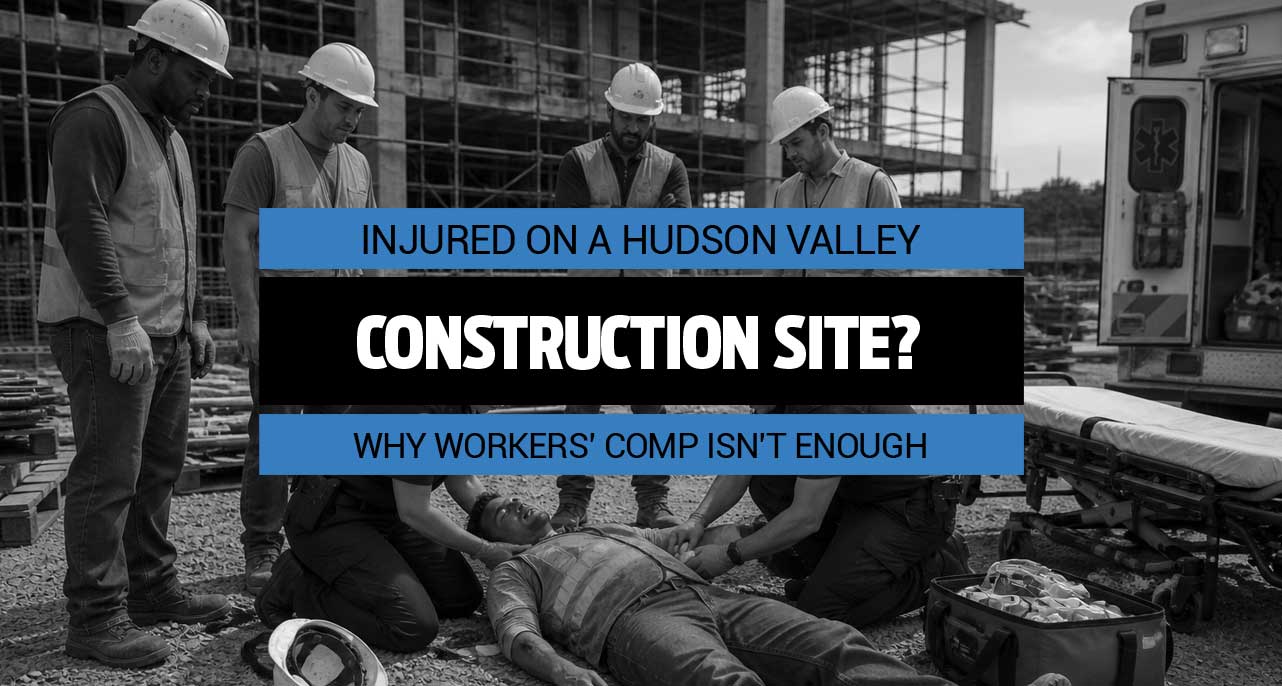
The Hudson Valley is experiencing a massive boom in real estate development, infrastructure upgrades, and commercial construction. From new apartment complexes in Poughkeepsie to historic renovations in Kingston and Newburgh, construction crews are working around the clock.
Unfortunately, construction remains one of the most dangerous industries in New York.
When a worker suffers a devastating injury on a job site—such as falling from a roof, a collapsing scaffold, or an unsecured ladder—they are usually told to file for Workers’ Compensation. While Workers’ Comp is important, it is rarely enough to protect your family’s financial future.
At O’Connor & Partners, PLLC, we want every local tradesman, laborer, and union worker to know the “best-kept secret” in New York personal injury law: The Scaffold Law. Here is how this unique law allows severely injured workers to bypass the limits of Workers’ Comp and pursue compensation from other potential insurance policies.
The Problem with Workers’ Compensation
By law, if you are injured while working, you cannot sue your direct employer for negligence. In exchange for giving up the right to sue your boss, you get Workers’ Compensation.
Workers’ Comp pays for your medical bills and a portion of your lost wages (usually about two-thirds of your average weekly wage). However, Workers’ Comp pays absolutely nothing for:
- Your physical pain and suffering.
- Your emotional distress.
- The loss of enjoyment of your life.
- The remaining portion of your lost income and future earning capacity.
If a severe spinal injury or traumatic brain injury ends your career at age 40, living on a fraction of your previous wages is a recipe for bankruptcy. That is where New York Labor Law steps in.
The Game Changer: New York Labor Law 240 (The Scaffold Law)
New York is the only state in the country with a law specifically designed to protect construction workers from gravity-related hazards.
Under New York Labor Law Section 240(1), commonly known as the “Scaffold Law,” property owners and general contractors have an absolute, non-delegable duty to provide proper safety equipment to workers operating at elevated heights. This includes providing safe scaffolding, ladders, hoists, harnesses, and guardrails.
“Strict Liability” Explained: If a general contractor or property owner fails to provide adequate safety equipment, or if that equipment fails, they are held strictly liable for your injuries. This means:
- You do not have to prove they were actively negligent. The simple fact that the ladder slipped or the scaffold collapsed is often enough to prove liability.
- Your own mistakes rarely matter. Even if you made a slight mistake that contributed to your fall, the owner/contractor is still legally responsible for failing to secure the site properly.
What Types of Accidents Does the Scaffold Law Cover?
Labor Law 240 covers two primary types of “gravity-related” construction accidents:
- Falling Workers: You fall from a roof, a ladder, a scaffold, an elevated platform, or into an unprotected hole/shaft.
- Falling Objects: A heavy object (like a tool, building material, or debris) falls from an elevated height and strikes you, because it was not properly hoisted or secured.
Third-Party Lawsuits: Suing the Real Culprits
Because you cannot sue your direct employer (e.g., your specific framing or plumbing subcontractor), a Scaffold Law case is filed as a “Third-Party Lawsuit.”
Our attorneys file the lawsuit directly against the Property Owner, the General Contractor (GC), or the Construction Manager. These entities carry massive, multi-million dollar commercial insurance policies specifically designed to pay out these types of claims.
This allows you to collect your Workers’ Compensation benefits to keep your head above water right now, while we simultaneously sue the General Contractor to secure a financial settlement for your pain, suffering, and total lost career earnings.
A Note for Undocumented Workers in New York
Many injured laborers in the Hudson Valley do not pursue legal action because they are undocumented and fear deportation.
Hear this clearly: Under New York State law, your immigration status has absolutely no bearing on your right to file a Labor Law 240 lawsuit. You have the exact same rights to a safe workplace, and the exact same right to sue a negligent contractor for compensation, as a U.S. citizen. At O’Connor & Partners, your consultation is strictly confidential.
Protect Your Family and Your Future
Construction accident cases require immediate investigation. General contractors will quickly fix broken ladders, alter the scene, and pressure witnesses to stay quiet.
If you or a loved one has suffered a severe gravity-related injury on a construction site in Ulster, Dutchess, Orange, or the surrounding counties, you need aggressive local representation. The trial attorneys at O’Connor & Partners, PLLC have the resources, the experts, and the aggressive litigation tactics necessary to take on the biggest construction companies in the state.
Contact us today for a free, no-obligation consultation. We charge no upfront fees, and you pay us absolutely nothing unless we win your case.