
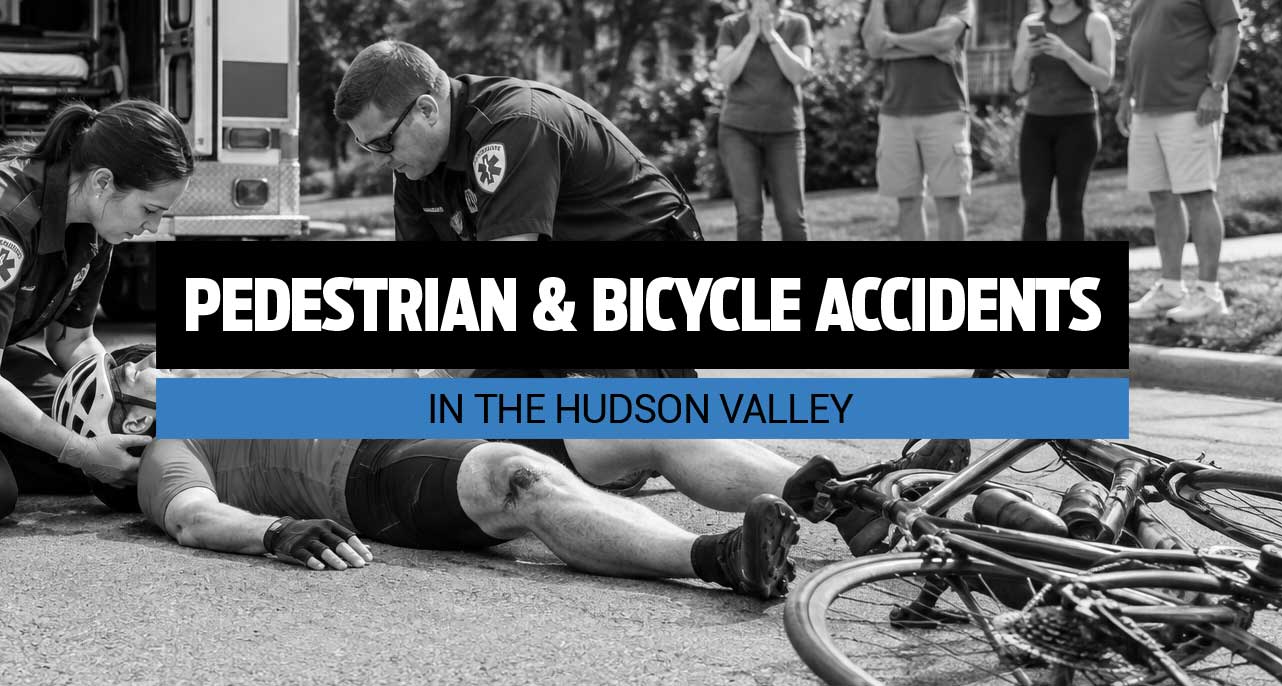
Pedestrian and bicycle accidents can leave victims with devastating injuries, permanent disabilities or, in the worst cases, fatal consequences. Across the Hudson Valley, residents share roads with cars, pickup trucks, SUVs and commercial vehicles, sometimes in areas where sidewalks, protected bicycle lanes and safe pedestrian crossings are limited.
A recent investigation by the Times Union, examining fatal pedestrian and bicyclist crashes between 2020 and 2024, highlights the scale of the problem. According to the newspaper’s analysis of National Highway Traffic Safety Administration data, the Hudson Valley averaged approximately 35 pedestrian and bicyclist deaths in motor vehicle crashes each year during that period.
The findings raise important questions about road safety, driver responsibility and the legal options available to people injured in pedestrian and bicycle accidents.
For individuals and families dealing with the aftermath of a serious collision, understanding New York’s traffic laws and personal injury rules can be an important first step.
Pedestrian and Bicycle Fatalities Remain a Serious Hudson Valley Concern
The Times Union analysis covered 15 New York counties, including Dutchess, Orange, Ulster, Putnam, Westchester, Rockland, Sullivan and Greene counties.
Across the Hudson Valley, the newspaper reported an average of approximately 35 pedestrian and bicyclist deaths annually between 2020 and 2024. The analysis also identified several recurring circumstances associated with fatal crashes, including nighttime conditions, pedestrians or cyclists in travel lanes, and locations without sidewalks.
The report found that more than one-third of fatal pedestrian and bicyclist crashes occurred between 7 p.m. and midnight. It also reported that roughly two-thirds of fatal crashes occurred while the pedestrian or bicyclist was in a travel lane, and a similar proportion occurred at locations without a sidewalk.
These findings illustrate why pedestrian and bicycle safety requires attention from drivers, road users and the agencies responsible for roadway design and maintenance.
Read the Times Union’s investigation into fatal pedestrian and bicyclist crashes for the full regional analysis.
Why Are Pedestrian Accidents So Dangerous?
Pedestrians have little physical protection when struck by a motor vehicle. Even a collision at a relatively low speed can cause serious injuries, while higher-speed impacts can have catastrophic consequences.
The risk can increase when drivers fail to notice pedestrians, approach intersections too quickly or make turns without checking crosswalks.
Several factors may contribute to pedestrian accidents in the Hudson Valley.
Speeding and Failure to Exercise Due Care
Speed affects both a driver’s ability to stop and the severity of a collision. A driver traveling too quickly for traffic, visibility or roadway conditions may have less time to recognize a pedestrian and avoid a crash.
New York Vehicle and Traffic Law § 1146 requires drivers to exercise due care to avoid colliding with pedestrians and bicyclists on roadways.
The statute is available through the New York State Senate’s official legislation website.
Whether a driver violated this duty in a particular accident depends on the circumstances and the available evidence.
Drivers Turning at Intersections
Turning vehicles can create serious hazards for pedestrians crossing a street. Drivers may focus on approaching traffic while overlooking someone already in a crosswalk or preparing to cross.
Left turns, right turns and turns made across bicycle lanes can all create collision risks when drivers fail to look carefully in every direction.
New York’s Department of Motor Vehicles driver guidance advises motorists to watch for pedestrians and check carefully before turning.
Poor Visibility After Dark
The Times Union investigation found that 85 of the 236 pedestrians killed in the regional crashes analyzed between 2020 and 2024 died in crashes occurring between 7 p.m. and midnight.
Reduced visibility can make it harder for drivers to see someone walking near the roadway, crossing between vehicles or approaching an intersection.
Street lighting, vehicle headlights, weather, glare and the position of a pedestrian can all affect visibility. However, darkness does not automatically excuse a driver’s failure to exercise reasonable care.
Roads Without Sidewalks or Safe Crossings
The absence of a sidewalk can force pedestrians to walk close to moving traffic. On busy roads, this can leave little room for error when a vehicle passes too closely or moves out of its lane.
Long distances between intersections may also encourage people to cross midblock, particularly when they are trying to reach a bus stop, shop or workplace.
The absence of sidewalks or other safety infrastructure does not, by itself, establish legal liability for a municipality or driver. However, roadway conditions may be relevant when investigating how an accident occurred and whether another party’s conduct contributed to it.
Bicycle Accidents on Hudson Valley Roads
Bicyclists face many of the same dangers as pedestrians, with additional risks when sharing a roadway with motor vehicles.
A collision can throw a cyclist onto the pavement or into another vehicle’s path. Injuries may include broken bones, traumatic brain injuries, spinal cord damage, internal injuries and permanent disability.
The Times Union reported that bicyclist deaths remained below 10 annually across the Capital Region and Hudson Valley during the five-year period examined. Although the number was lower than pedestrian fatalities, the consequences of an individual bicycle crash can still be severe.
Common situations that can lead to bicycle accidents include:
- Drivers turning across a cyclist’s path.
- Vehicles passing too closely.
- Drivers opening car doors into a cyclist’s path.
- Motorists entering intersections without checking for bicycles.
- Distracted or impaired driving.
- Speeding on roads shared with cyclists.
- Vehicles blocking designated bicycle lanes.
- Collisions involving unsafe passing or lane changes.
New York Vehicle and Traffic Law § 1146 requires drivers to exercise due care around bicyclists. Section 1122-a also addresses passing bicycles, requiring motorists overtaking a bicycle to pass to its left at a safe distance until safely clear.
The official statutes are available at VTL § 1146 and VTL § 1122-a.
Who Is Liable for a Pedestrian or Bicycle Accident in New York?
When a pedestrian or bicyclist is injured in a collision, determining who is legally responsible requires an examination of the facts.
A driver may be liable when negligent conduct causes an accident and resulting injuries. Examples may include speeding, distracted driving, failing to yield when required, making an unsafe turn or failing to take reasonable steps to avoid a collision.
However, not every accident establishes negligence, and responsibility cannot be determined solely from the severity of the injuries.
An investigation may consider:
- The driver’s actions before the collision.
- The pedestrian’s or cyclist’s position and movements.
- Traffic signals and right-of-way rules.
- Vehicle speed and stopping distance.
- Roadway design and visibility.
- Witness statements.
- Photographs and video recordings.
- Police reports and accident reconstruction evidence.
- Whether another party’s conduct contributed to the incident.
In some cases, the investigation may also examine whether a municipality, property owner, vehicle manufacturer or another party contributed to the dangerous conditions or collision.
A potential claim against a municipality can involve special legal requirements, including notice-of-claim rules and shorter deadlines. These cases should be evaluated promptly.
What if the Pedestrian Was Not in a Crosswalk?
A pedestrian accident does not automatically become the pedestrian’s fault simply because the person was crossing outside a marked crosswalk.
New York law establishes different duties depending on where and how a pedestrian crosses. Under Vehicle and Traffic Law § 1152, pedestrians crossing outside a marked crosswalk or an unmarked crosswalk at an intersection generally must yield the right of way to vehicles on the roadway.
At the same time, drivers remain subject to their legal duties, including the duty to exercise due care to avoid collisions with pedestrians.
New York also applies comparative-negligence principles in many personal injury cases. Under Civil Practice Law and Rules § 1411, a claimant’s culpable conduct generally does not automatically prevent recovery, although it can reduce damages in proportion to the claimant’s share of responsibility.
The result depends on the evidence, the applicable law and the circumstances of the collision.
What Compensation May Be Available After a Pedestrian or Bicycle Accident?
A serious pedestrian or bicycle accident can create financial consequences that extend well beyond the initial emergency treatment.
Depending on the circumstances and the available evidence, an injured person may be entitled to pursue compensation for several categories of damages.
Medical Expenses
Compensation may include eligible expenses for emergency care, hospitalization, surgery, medication, rehabilitation and follow-up treatment.
When an injury requires continuing medical care, future treatment costs may also be relevant to the claim.
Lost Wages
An injury may prevent someone from returning to work for days, weeks or longer. A claim may include documented lost income when the loss is legally recoverable and supported by evidence.
Reduced Earning Capacity
Severe injuries can affect a person’s ability to perform their job or pursue the same career opportunities as before the accident. Evidence concerning long-term physical limitations and employment prospects may be necessary to establish this type of loss.
Pain and Suffering
Physical pain, permanent scarring, loss of mobility and limitations on everyday activities may support a claim for non-economic damages, depending on the applicable law and circumstances.
Long-Term Care and Rehabilitation
Some victims need ongoing physical therapy, assistive devices, home modifications or other support because of permanent injuries.
The extent of these needs can be particularly important in cases involving traumatic brain injuries or spinal cord damage.
The value of a claim depends on the severity of the injuries, the evidence of liability, the financial and personal consequences, applicable insurance coverage and other case-specific factors. No particular outcome or settlement amount can be guaranteed.
What Happens When a Pedestrian or Cyclist Is Killed?
Fatal pedestrian and bicycle accidents can leave families facing profound emotional and financial consequences.
When a person’s death was caused by another party’s wrongful conduct, eligible survivors may have legal options under New York’s wrongful death laws.
A wrongful death claim may involve an investigation into the collision, the parties involved and the damages recoverable under New York law.
Depending on the facts, relevant issues may include:
- The circumstances that caused the crash.
- Whether a driver or another party was negligent.
- Medical expenses related to the fatal injury.
- Funeral and burial expenses.
- The financial support the deceased would have provided.
- Other damages permitted under New York law.
New York wrongful death claims have specific statutory requirements concerning who may bring an action and which damages may be recovered. The rules are more limited than some families may expect, so legal advice should be obtained rather than assuming every emotional or personal loss is independently compensable.
Families should also be aware that claims involving public entities may have additional notice requirements.
What Should You Do After a Pedestrian or Bicycle Accident?
If you or someone in your family has been injured in a collision, the following steps may help protect your health and preserve evidence.
1. Seek medical attention. Some serious injuries, including head injuries and internal injuries, may not be immediately apparent.
2. Report the accident. Contact the appropriate emergency services or law enforcement when necessary, and make sure the incident is documented.
3. Preserve evidence. If it is safe to do so, photograph the scene, vehicle damage, bicycle damage, visible injuries, traffic signals and roadway conditions.
4. Obtain witness information. Names and contact details may help investigators understand what happened.
5. Keep medical and financial records. Save treatment records, bills, receipts and documentation of missed work.
6. Preserve video evidence. Dashcams, security cameras and nearby businesses may have recordings that are not retained indefinitely.
7. Be cautious with insurance statements. Before signing a release or accepting a settlement, understand whether it could affect your ability to pursue additional compensation.
8. Obtain legal guidance promptly. Personal injury claims are subject to deadlines, and claims against municipalities may have additional procedural requirements.
Pedestrian and Bicycle Accident Representation Throughout the Hudson Valley
O’Connor & Partners, PLLC represents individuals injured in motor vehicle, pedestrian and bicycle accidents throughout the Hudson Valley and other parts of New York.
The firm serves clients in communities including Kingston, Newburgh and Poughkeepsie, as well as other surrounding areas.
For people injured while walking or cycling, the legal issues may involve driver negligence, right-of-way rules, road conditions, insurance coverage and the long-term consequences of serious injuries.
The firm’s bicycle accident lawyers handle bicycle injury matters, while its car accident attorneys provide information about motor vehicle accident claims. People with serious injuries can also learn more about the firm’s serious injury attorneys.
The firm has offices in Kingston, Newburgh and Poughkeepsie. Visit the firm’s contact page to discuss a potential case.
Understanding Your Legal Options After a Hudson Valley Pedestrian Accident
The Times Union’s analysis highlights a continuing safety concern across the Hudson Valley: pedestrians and bicyclists remain vulnerable when sharing roads with motor vehicles, especially in areas with limited pedestrian infrastructure and reduced nighttime visibility.
For someone injured in a collision, the next steps involve more than recovering from physical injuries. Understanding what caused the accident, preserving evidence and determining whether another party may be legally responsible can all be important.
Every case is different, and the available legal options depend on the facts and applicable New York law.
O’Connor & Partners, PLLC represents injured people and families in serious accident matters throughout the Hudson Valley. If you or a family member has been injured in a pedestrian or bicycle collision, contact the firm to discuss the circumstances and learn what options may be available.
Contact O’Connor & Partners, PLLC to request a case review.
This article provides general information about New York law and is not legal advice. A specific case requires an assessment of its facts, evidence and applicable legal requirements.