
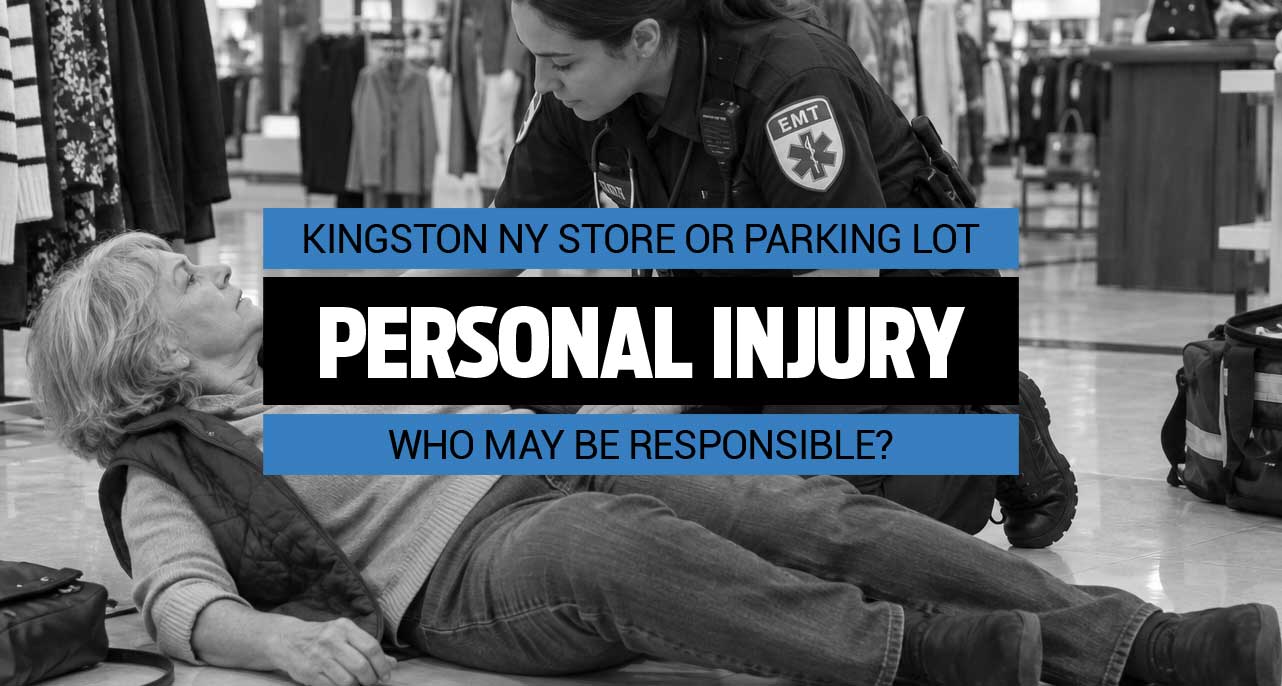
You walk into a store in Kingston to pick up a few things. A few minutes later, you are on the floor with a badly injured ankle.
Or perhaps you are walking through a parking lot when you trip over broken pavement.
At first, you may not think much about what caused the fall. You are more concerned with the pain and whether you need to go to the emergency room.
Then the medical bills start arriving.
You may also miss work, need physical therapy, or find that an injury that initially seemed minor is taking much longer to heal than expected.
At that point, a natural question is: Who is responsible for my injury?
The answer is not always straightforward.
An injury on someone else’s property does not automatically mean they are liable
New York property owners and businesses have responsibilities to people who are lawfully on their property. But that does not mean a property owner is automatically responsible every time someone falls.
The circumstances surrounding the accident matter.
For example, there is a difference between tripping over a condition that was completely unexpected and obvious and falling because of a dangerous condition that a property owner knew about, or reasonably should have known about, and failed to address.
The question is often not simply whether a dangerous condition existed.
It is whether the property owner or another responsible party had a legal duty concerning that condition and failed to act reasonably.
Where can these accidents happen in Kingston?
A premises liability accident can happen almost anywhere.
A person may be injured in:
- A grocery store
- A restaurant
- A shopping center
- A parking lot
- An apartment building
- An office building
- A hotel
- A sidewalk
- A stairway
- A public or commercial property
The type of property can affect who may ultimately be responsible.
For example, the owner of a building may not be the same entity that operates a business inside it. A property may also be managed by a separate management company or maintained by another contractor.
That is one reason identifying the responsible party can sometimes require more investigation than simply looking at the name on the front door.
Common causes of Kingston slip and fall accidents
Not every fall is caused by a dramatic hazard.
Sometimes the problem is something surprisingly ordinary.
Wet floors, spilled liquids, uneven pavement, broken stairs, poor lighting, loose flooring, snow and ice, or debris can all potentially contribute to an accident.
Parking lots can present their own problems, including potholes, cracks, poor lighting, inadequate drainage, or other dangerous conditions.
The important question is what caused your particular accident and whether someone responsible for the property had a duty to address that condition.
What should you do immediately after a fall?
If you are injured on someone else’s property, try not to leave without documenting what happened if your condition allows you to do so.
Take photographs of the exact area where you fell.
Do not just photograph your injuries or damaged clothing. Photograph the condition that caused the accident.
For example, if you tripped over broken pavement, take pictures showing the damaged pavement and the surrounding area.
If you slipped on a wet floor, document the location and, if possible, what was on the floor.
Try to take photographs from different distances so that someone who was not at the scene can understand exactly where the accident happened.
Report the accident
Tell the store, property manager, landlord, or another appropriate person that you were injured.
If the business has an incident report, ask for information about the report and keep any paperwork you receive.
Be factual when describing what happened.
You do not need to decide at the scene who was legally responsible.
You also should not feel pressured to say that you were not hurt simply because the injury does not appear serious at first.
Look for witnesses
If somebody saw you fall, get their name and contact information if possible.
A witness may be able to confirm what the area looked like before or immediately after the accident.
This can become important if there is later a disagreement about whether the dangerous condition existed.
For example, a store employee may say that the floor was dry when you fell. A customer who was standing nearby may have seen the spill beforehand.
Witness information can become much harder to obtain after you leave.
What if there were security cameras?
Many businesses use surveillance cameras.
If you were injured inside a store, restaurant, apartment building, or parking lot, there may be video showing the accident or the condition that caused it.
That footage can be extremely useful, but it may not be retained indefinitely.
If your injury is serious, preserving potentially relevant video can become an important part of investigating the accident.
This is one reason it can be beneficial to speak with an attorney relatively soon after a serious premises liability accident.
What does “notice” have to do with a slip and fall?
One of the important issues in many premises liability cases is whether the property owner knew, or should reasonably have known, about the dangerous condition.
There are different ways that this may be established.
Someone may have directly reported the condition to an employee.
An employee may have seen it.
Or the condition may have existed long enough that a reasonable property owner or business should have discovered it.
The specific facts matter.
A puddle that appeared moments before an accident can raise different questions from a recurring leak that has allegedly been present for weeks.
What if the condition was on a sidewalk or outside a business?
Determining responsibility can become more complicated when an accident occurs outside.
A sidewalk, curb, parking area, or other portion of a property may be owned, maintained, or controlled by different parties.
In Kingston, as in other New York communities, the location of the accident can therefore matter when determining who had responsibility for the area.
Do not assume that the nearest business automatically owns or controls the sidewalk where you fell.
That is something that may need to be investigated.
What if you were injured in a parking lot?
Parking lot accidents deserve particular attention because they can involve both property conditions and vehicle traffic.
A person could be injured after tripping over a pothole or uneven pavement. Someone could also be struck by a vehicle while walking through a parking lot.
In either situation, photographs of the location can be important.
If a vehicle was involved, preserve information about the driver and vehicle as well as any witness information.
If there are nearby businesses, security cameras may also provide evidence of what happened.
What if the property owner says the condition was obvious?
A property owner or insurance company may argue that the condition should have been obvious to you.
That does not automatically answer whether a claim exists.
The circumstances of the accident still need to be examined, including the condition itself, the surrounding area, lighting, warnings, how the accident occurred, and other relevant facts.
There is no single rule that can determine every slip-and-fall case without looking at the details.
Keep your shoes and clothing
This may sound like a small detail, but keep the shoes and clothing you were wearing when you were injured.
If your footwear was damaged or there is something on the clothing that helps demonstrate what happened, do not throw it away.
Put the items somewhere safe.
They may never become important to the case, but once something is discarded, it cannot easily be recovered.
Keep track of your medical treatment
After an injury, follow the treatment recommended by your medical providers and keep copies of your records and bills.
Keep track of appointments, prescriptions, physical therapy, and other treatment.
If the injury causes you to miss work, keep documentation of the time you missed and any resulting loss of income.
It can also help to make notes about how the injury affects ordinary activities.
An injury can have consequences that are not reflected in a medical bill.
How long do you have to bring a claim?
New York has legal deadlines for personal injury claims, but the applicable deadline can depend on the circumstances.
The rules may also differ when the property involved is owned by a governmental entity or another party subject to special requirements.
For that reason, someone who has suffered a significant injury should not assume there is plenty of time simply because the accident happened recently.
Getting legal advice early can help identify the applicable deadlines and determine what evidence should be preserved.
Do you need a Kingston personal injury lawyer?
Not every minor fall requires a lawsuit.
But if you suffered a significant injury, required substantial medical treatment, missed work, or believe that a dangerous property condition caused your accident, it can be worthwhile to have the circumstances reviewed by an attorney.
A lawyer can investigate who owned or controlled the property, whether there may have been prior complaints, whether photographs or surveillance footage exist, and what insurance coverage may apply.
Most importantly, you do not have to determine all of that on your own immediately after an injury.
Injured on someone else’s property in Kingston?
A fall in a store, parking lot, apartment building, restaurant, or other property can leave you dealing with much more than the accident itself.
If you were injured because of a potentially dangerous condition in Kingston or elsewhere in Ulster County, the circumstances of the accident deserve careful attention.
O’Connor & Partners, PLLC represents people injured in premises liability and other personal injury cases throughout the Hudson Valley.
If you have been injured on someone else’s property, contact O’Connor & Partners, PLLC to discuss what happened and learn what legal options may be available.