
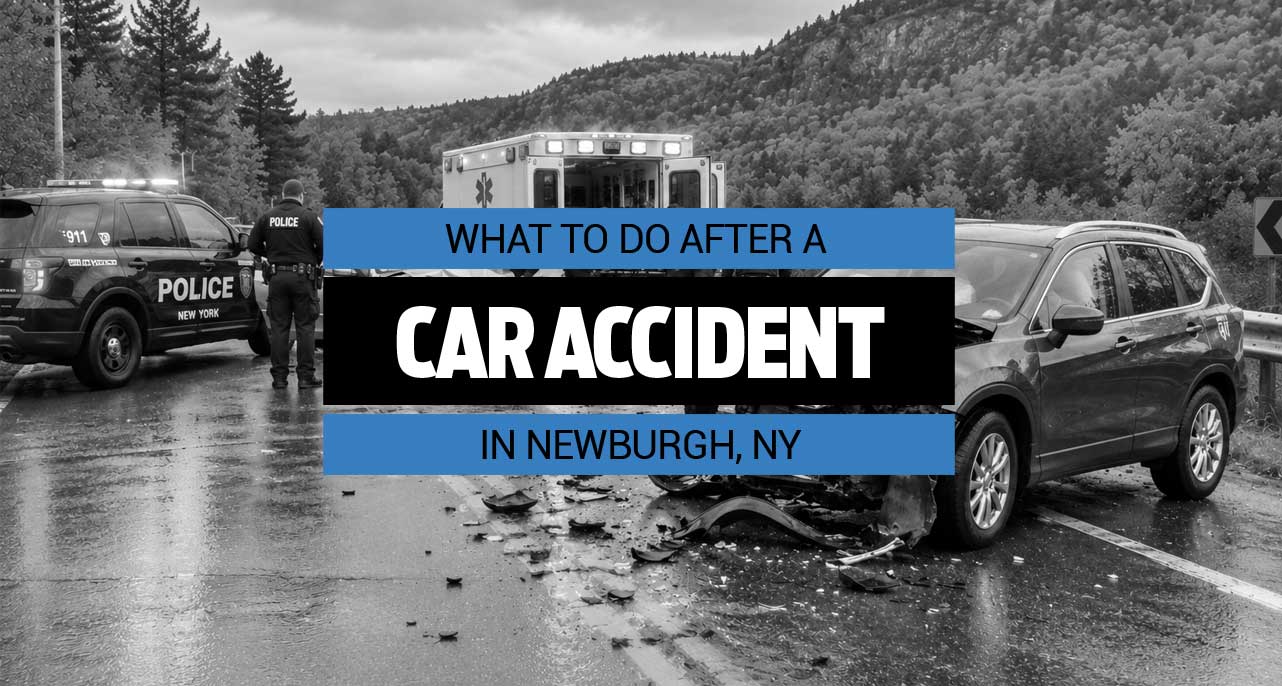
A car accident can happen in a matter of seconds. One moment you are driving through Newburgh, heading home from work or making your way across the Hudson Valley, and the next you are dealing with damaged vehicles, injuries, police officers, and insurance companies.
If you have never been involved in a serious accident before, it can be difficult to know what you are supposed to do next.
Should you call the police? Do you need to go to the hospital if you feel fine? What information should you collect? When should you contact a lawyer?
The right steps can depend on the circumstances of the crash, but there are some things every New York driver should know after an accident.
Call the police
Even when an accident initially appears to be minor, reporting the collision can be important.
The responding officer may document the location, vehicles, apparent damage, statements from the drivers and witnesses, and other circumstances surrounding the crash.
If you are injured, make sure you tell the officer.
It is also a good idea to obtain information about the police report and how you can get a copy later.
A police report is not necessarily the final word on who is legally responsible for an accident. However, it can become an important piece of evidence when the circumstances of a collision are later disputed.
Get medical attention if you are hurt
Some injuries are obvious immediately after a crash. Others are not.
Neck and back injuries, concussions, soft-tissue injuries, and other conditions may not become apparent until hours or even days after an accident.
If you are experiencing pain or other symptoms, get evaluated by a medical professional.
Even if you initially feel fine, pay attention to how you feel afterward.
One common mistake after a crash is telling everyone at the scene that you are “fine” simply because you are able to get out of the vehicle and walk around. You may not yet know the extent of your injuries.
Your health should come before worrying about the insurance claim.
Photograph the accident scene
If you can safely do so, take photographs before the vehicles and surrounding conditions change.
Try to document:
- Damage to your vehicle
- Damage to the other vehicle or vehicles
- The position of the vehicles
- Traffic signs and signals
- Road markings
- Skid marks or debris
- The surrounding roadway
- Any visible injuries
- Damage to guardrails, poles, signs, or other property
Take photographs from several angles rather than relying on one picture.
If the accident occurred at an intersection, photograph the intersection itself. The layout of the roadway, signs, traffic signals, lanes, and surrounding visibility may become relevant later.
Get information from witnesses
If someone saw what happened, ask for their name and contact information.
A witness may have seen something you did not.
For example, you may not have seen the other vehicle approach because your attention was focused on traffic ahead. A person standing nearby may have seen the other driver using a phone, running a traffic light, changing lanes, or making another maneuver immediately before the crash.
Do not assume that a witness will automatically be identified in the police report.
If someone witnessed the accident and is willing to provide their information, keep it somewhere safe.
Be careful about what you say after the accident
People are often shaken immediately after a crash.
You may find yourself apologizing or saying something such as, “I didn’t see you,” even though you do not yet understand exactly what happened.
Try to stick to the facts.
You do not need to argue with the other driver about who caused the accident. You also do not need to make a legal determination at the side of the road.
Let the police investigate and preserve your own evidence.
What if the accident happened on I-84?
Crashes on I-84 can create additional complications because of the volume of traffic and the speed at which vehicles are traveling.
If your accident occurred on I-84 near Newburgh, preserve as much information as possible about the exact location and circumstances.
The Newburgh-Beacon Bridge and its approaches can involve merging traffic, changing lanes, and vehicles traveling through the area for very different reasons.
If a collision involves multiple vehicles, commercial trucks, or serious injuries, determining what happened may require more than simply comparing the statements of the drivers.
What if the crash happened on Route 9W?
Route 9W passes through Newburgh and the surrounding Hudson Valley communities and carries both local and through traffic.
A collision on Route 9W may involve a number of potential factors, including turning vehicles, intersections, lane changes, traffic entering or leaving businesses, and roadway conditions.
The exact location matters.
If you were involved in a crash on Route 9W, make a note of the nearest intersection, business, landmark, or other identifiable location.
That information can make it easier to locate the accident scene and identify potential sources of evidence.
What about an accident on Broadway?
Broadway runs through Newburgh and includes areas with businesses, intersections, pedestrians, parked vehicles, and other sources of traffic.
If your accident happened on Broadway, there may potentially be additional evidence beyond the vehicles themselves.
Nearby businesses may have exterior security cameras. There may have been pedestrians or other motorists who witnessed the collision.
Surveillance footage can also be temporary, which is one reason evidence should be considered early after a serious accident.
What happens with insurance after a New York car accident?
New York’s automobile insurance system can be confusing, particularly when you are injured.
New York is a no-fault state. In general, no-fault insurance is intended to provide certain benefits for medical expenses and lost earnings after a motor vehicle accident, regardless of who caused the accident.
That is different from a personal injury claim against the driver who caused the crash.
Whether you can pursue compensation for pain and suffering and other damages depends on the circumstances of the accident and the injuries involved.
Serious injuries can also create questions about the insurance coverage available, the identity of potentially responsible parties, and whether additional claims may exist.
Should you speak with the other driver’s insurance company?
You will generally need to cooperate with your own insurance company and follow the requirements of your policy.
However, you should be cautious about giving statements or signing documents relating to an injury claim against another party without understanding what you are agreeing to.
Insurance companies investigate accidents from their own perspective.
If you have suffered significant injuries, you may want to have an attorney review the situation before making decisions that could affect your claim.
What if you were not driving?
Passengers can also suffer serious injuries in car accidents.
If you were a passenger in a vehicle involved in a Newburgh accident, do not assume that you cannot pursue a claim simply because you were not driving.
Depending on the circumstances, there may be insurance coverage available through the vehicle in which you were riding or through another applicable policy.
The potential claims depend on the facts of the accident and the applicable insurance rules.
What if the other driver was uninsured?
An accident becomes more complicated when the driver who caused the collision does not have adequate insurance or does not have insurance at all.
New York has insurance requirements and protections that may apply in these situations, but the available coverage depends on the particular circumstances and policies involved.
If you were seriously injured by an uninsured or underinsured driver, it is worth having the available insurance coverage reviewed carefully.
Keep records of everything
After a serious accident, create a file for anything related to the collision.
Keep copies of:
- Medical records
- Medical bills
- Prescription expenses
- Insurance correspondence
- Police reports
- Repair estimates
- Photographs
- Pay stubs or employment records showing lost time from work
- Notes about your symptoms and treatment
It is also helpful to keep a simple record of appointments and how your injuries are affecting your normal activities.
These details can become important when the full impact of an accident is being evaluated.
Do not assume that a minor-looking accident means minor injuries
Vehicle damage does not always tell the whole story.
Modern vehicles can absorb substantial impact, while the people inside the vehicle may still suffer injuries.
Likewise, a collision that does not appear dramatic at the scene can result in weeks or months of medical treatment.
If you were injured, the fact that you were able to leave the scene under your own power does not necessarily mean that you were unharmed.
When should you contact a Newburgh personal injury attorney?
Not every fender-bender requires a lawyer.
A legal consultation may be particularly useful if you suffered significant injuries, your treatment is ongoing, you cannot work because of the accident, the other driver disputes responsibility, or an insurance company is questioning your claim.
An attorney can review the circumstances of the collision and explain what legal options may be available.
That review can also help identify issues that may not be obvious immediately after an accident.
For example, liability may not always be limited to the driver. Depending on what happened, there may be questions involving another vehicle, a commercial carrier, a vehicle owner, or a roadway condition.
What should you do now?
If you have been injured in a Newburgh car accident, focus first on getting the medical care you need.
Then preserve the information you have about the accident.
Photographs, witness information, medical records, the police report, and insurance documents can all become important later.
Most importantly, do not assume that you have no legal options simply because the insurance company has already contacted you or because you initially thought your injuries were minor.
Injured in a car accident in Newburgh?
A car accident can affect much more than your vehicle. Serious injuries can lead to medical treatment, lost income, ongoing pain, and uncertainty about what happens next.
O’Connor & Partners, PLLC represents people injured in car accidents and other personal injury matters in Newburgh and throughout the Hudson Valley.
If you were injured in a collision on I-84, Route 9W, Route 17K, Broadway, or another road in the Newburgh area, the circumstances of your accident can be reviewed to determine what legal options may be available.
Contact O’Connor & Partners, PLLC to discuss your Newburgh car accident with an experienced personal injury attorney.